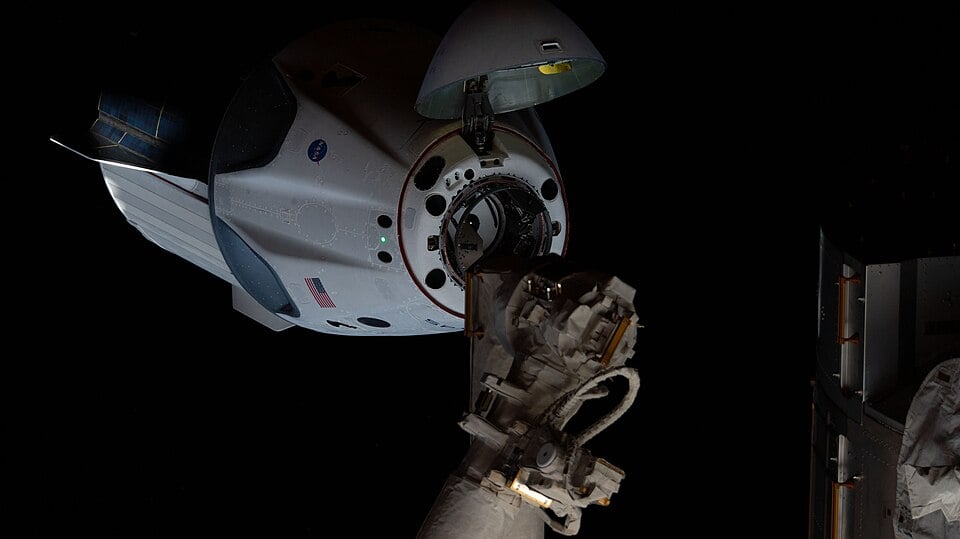
Stanford University engineers have developed an artificial intelligence system that allows spacecraft to autonomously navigate docking procedures with the International Space Station using a technique borrowed from neuroscience called reinforcement learning, or what researchers describe as teaching machines to "dream" their own solutions.
The Stanford team trained neural networks to handle the complex orbital mechanics involved in ISS rendezvous and docking operations. Unlike traditional pre-programmed flight sequences, this AI system learns by simulating thousands of hypothetical docking scenarios, refining its decision-making through trial and error in virtual environments before ever approaching the actual station.
Docking with the ISS presents extraordinary technical challenges. Spacecraft approach at roughly 28,000 kilometers per hour, moving in parallel with the station itself. Orbital mechanics operate under counterintuitive principles where accelerating forward causes lateral drift rather than speed increase. Traditional Newtonian physics governs the encounter, with no atmospheric friction to naturally slow descent. Any collision with the 420-ton laboratory complex would kill all personnel aboard both vehicles and generate a debris field threatening other orbital assets.
SpaceX Crew Dragon capsules currently use automated rendezvous systems developed by NASA and SpaceX engineers over decades, with human astronauts maintaining manual override capability throughout approach and docking sequences. These systems rely on pre-calculated guidance profiles and sensor feedback loops refined through hundreds of successful missions.
The Stanford approach introduces machine learning as an alternative framework. Rather than encoding every possible scenario into command sequences, researchers trained neural networks to develop their own problem-solving strategies. The AI system absorbed the underlying physics through simulation, learning how thruster burns, timing, and vector calculations interact within orbital mechanics constraints.
The research addresses a genuine operational need. Automated docking reduces crew workload during critical phases of spaceflight. It also enables autonomous operations for uncrewed cargo vehicles and future deep-space missions where communication delays make real-time human control impossible. NASA's future Artemis program and commercial lunar landers will require similarly robust autonomous guidance systems.
This work builds on decades of autonomous spacecraft research. NASA's Orbital Express mission in 2007 demonstrated autonomous rendezvous capabilities. The Russian Progress vehicles have conducted automated dockings with the ISS since 1978. SpaceX's Crew Dragon incorporated autonomous systems from its inception.
Stanford's contribution lies in demonstrating that machine learning can replicate and potentially exceed traditional guidance system performance. The neural networks don't just execute pre-programmed sequences. They adapt to off-nominal conditions and learn optimal trajectories through simulated experience.
The technology remains under development, with researchers working to validate performance across broader operational envelopes and edge cases. Full implementation would require extensive testing, certification from NASA and international space agencies, and integration with existing ISS safety protocols.
Successful autonomous docking systems accelerate the pace of space operations. They reduce the specialized training requirements for spacecraft operators and enable more frequent rendezvous missions. They also establish machine learning as a viable approach for other autonomous spacecraft functions, from station-keeping to orbital debris avoidance.