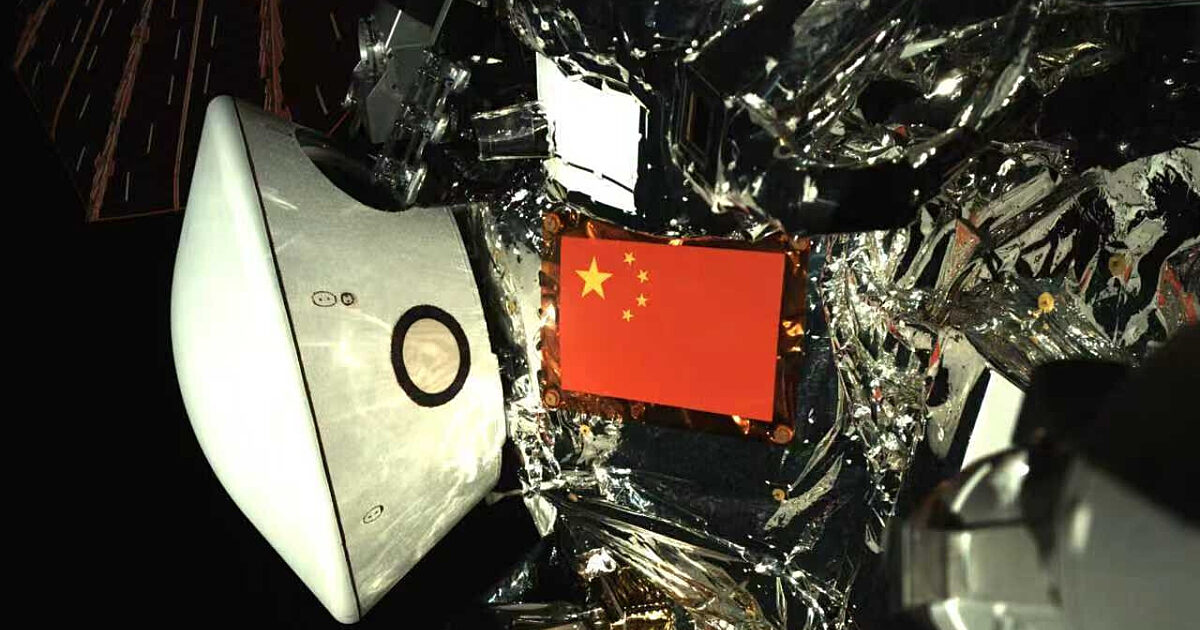
China's Tianwen-2 spacecraft has reached Kamo'oalewa, a quasi-moon orbiting Earth that Chinese scientists and the international community have targeted for sample return. The probe's arrival marks a watershed moment in planetary science, positioning China to become only the second nation to retrieve material from an asteroid.
Kamo'oalewa presents a unique target. This small asteroid, roughly 50 meters across, occupies a horseshoe orbit that keeps it locked in a complex gravitational dance with Earth. The quasi-moon approaches within 9 million kilometers of our planet before retreating, making it simultaneously nearby and dynamically unstable. This orbital geometry renders Kamo'oalewa accessible yet challenging, requiring precise navigation and timing to reach and escape.
The Tianwen-2 mission emerged from China's expanding asteroid exploration program. After the success of Chang'e lunar missions, the China National Space Administration (CNSA) began developing capabilities for deep space missions beyond Earth orbit. Kamo'oalewa offers an intermediate step between lunar operations and more distant asteroids, allowing engineers to test sample collection and return systems in a relatively accessible setting.
Retrieving samples from Kamo'oalewa carries scientific weight. Spectroscopic analysis suggests the asteroid shares compositional similarities with carbonaceous chondrite meteorites, a class of primitive materials that preserve chemical signatures from the early solar system. A sample collected and returned to Earth laboratories could answer questions about asteroid composition, water content, and organic chemistry. These findings would inform our understanding of how asteroids formed 4.6 billion years ago and what role they may have played in delivering volatiles to the early Earth.
The United States preceded China in asteroid sample return. NASA's OSIRIS-REx mission collected material from Bennu in 2020, and those samples arrived at Earth in September 2023. Japan's Hayabusa2 earlier retrieved particles from Ryugu. China's Tianwen-2 joins this growing fleet of sample-return spacecraft, diversifying the roster of asteroids studied at laboratory precision.
Tianwen-2 carries a robotic arm and collector mechanism designed for contact with low-gravity environments. The spacecraft must gently touch Kamo'oalewa's surface, gather material without becoming bound by the asteroid's minimal gravity, and execute a return trajectory to Earth. Any failure in sample containment or orbital mechanics would result in loss of the mission's primary objective.
The mission timeline spans several years. Following sample collection, Tianwen-2 must perform a departure burn to leave Kamo'oalewa's orbit, establish a return trajectory, and execute Earth re-entry. Chinese planners expect the sample capsule to touch down in Mongolia or another designated landing zone in 2025 or 2026.
Success would strengthen China's position as a spacefaring power capable of executing complex deep space missions. It would also expand humanity's collection of extraterrestrial materials available for study. The asteroid samples from multiple missions, analyzed side-by-side, will enable scientists to understand asteroid diversity and refine models of solar system formation.