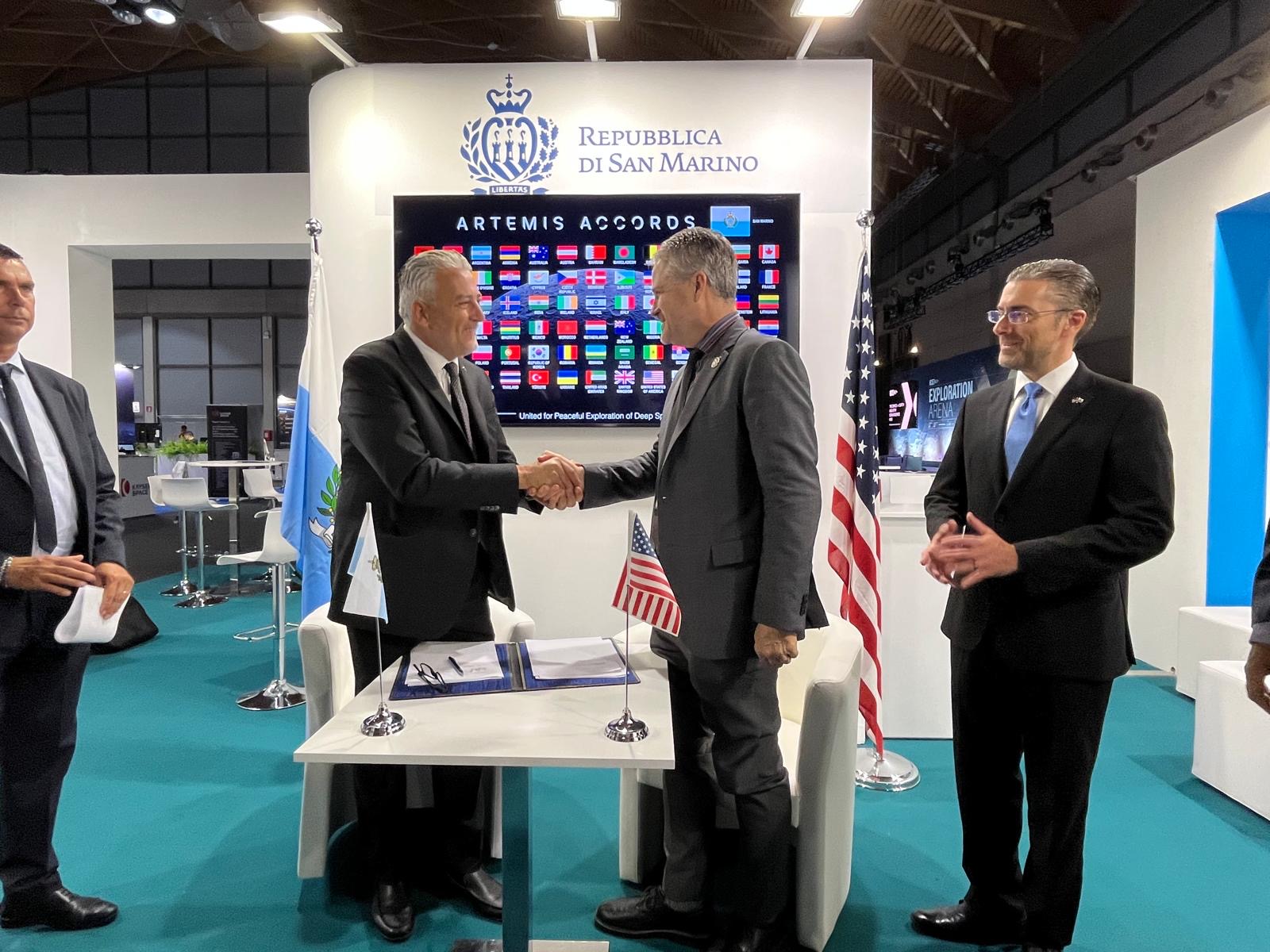
# NASA Welcomes San Marino as 76th Artemis Accords Signatory
The Republic of San Marino formally joined the Artemis Accords during a ceremony in Rimini on Friday, becoming the 76th nation to commit to NASA's framework for responsible space exploration. The milestone reflects accelerating international alignment around shared principles for the Moon, Mars, and beyond.
The Artemis Accords, established in 2020, set norms for peaceful and transparent space activities. Signatories pledge to conduct missions in compliance with the Outer Space Treaty, establish safety zones around lunar operations, and commit to open scientific data sharing. The framework does not require nations to participate in NASA's Artemis program itself. Rather, it creates a binding commitment to operational standards that reduce conflict and build trust in an era of expanding spacefaring capability.
San Marino's addition marks a steady expansion of the accords. When NASA and the U.S. Department of State introduced the framework, only eight nations signed initially. The growth to 76 signatories in four years demonstrates traction across regions with different space capabilities and strategic interests. Recent additions include Malaysia, Costa Rica, and nations from Africa, Asia, and Europe, suggesting the framework functions as a diplomatic tool beyond the traditional spacefaring powers.
The timing carries geopolitical weight. As China and Russia pursue parallel lunar programs outside the Artemis framework, the accords serve as a counterweight to reshape the terms of space competition. Unlike Cold War-era space races driven by superpower rivalry, the Artemis Accords attempt to establish rules before congestion in lunar orbit becomes a problem. The accords address resource extraction, scientific research, and debris management. They also require signatories to assist other nations in distress and maintain transparency about missions and safety protocols.
San Marino's signature, though the nation lacks active space launch capability, holds symbolic value. The historic microstate demonstrates that space governance transcends spacefaring status. Nations without rockets can still commit to responsible practices and participate in international space research through partnerships. This approach expands the diplomatic base for the framework and builds legitimacy for the accords as a universal standard rather than a tool of spacefaring elites.
NASA Deputy Administrator officials attended the Rimini ceremony, underscoring the State Department's diplomatic coordination. The U.S. has prioritized accords expansion as part of broader space strategy under the Biden administration. The framework supports American interests in establishing favorable conditions for lunar operations while building coalitions that isolate nations refusing to adopt these standards.
The accords face challenges ahead. Enforcement mechanisms remain weak. Several spacefaring nations, including India and Japan, have not yet signed despite space programs. Russia and China actively reject the framework, pursuing their own International Lunar Research Station accord. Ambiguities around resource rights and how safety zones function in practice could generate disputes as multiple nations land on the Moon simultaneously.
Nevertheless, 76 signatories represent a substantial global commitment to principles that prioritize transparency and safety. As Artemis missions accelerate toward lunar landing, the accords create the diplomatic infrastructure necessary to manage activity beyond Earth orbit. San Marino's signature adds momentum to a framework designed to ensure that space exploration benefits humanity collectively rather than breeding conflict on humanity's nearest neighbor.