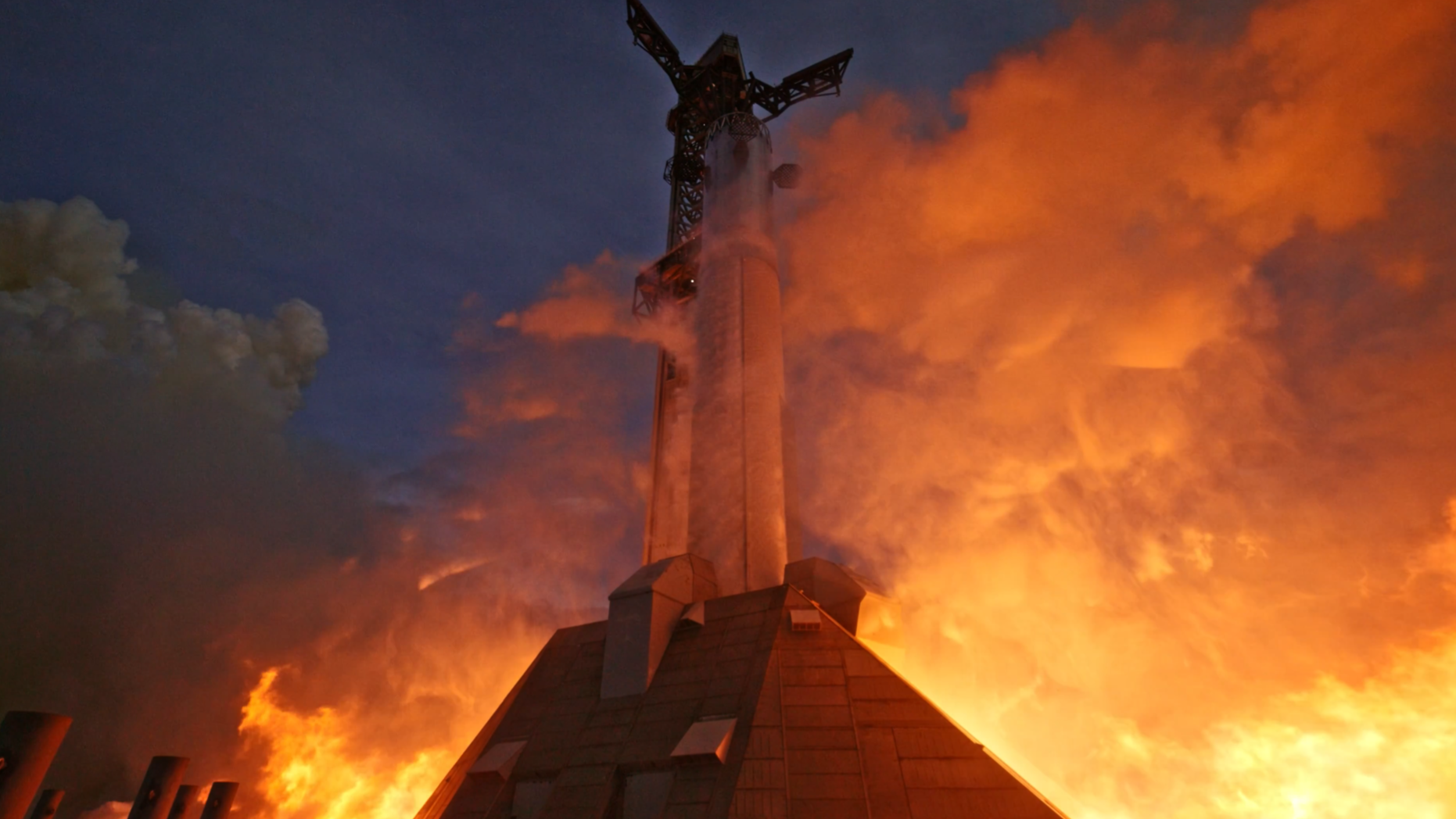
SpaceX ignited the 33 Raptor engines of its Super Heavy booster B22 during a static-fire test on October 25, marking the beginning of critical ground testing before Starship's Flight Test 15. The test took place at Starbase in Boca Chica, Texas, where the company methodically validates each booster before flight.
Static-fire tests burn engines while the vehicle remains bolted to the launch pad. Engineers collect data on engine performance, structural loads, and control systems under conditions that mirror actual flight. SpaceX has refined this approach across dozens of Starship integrated flight tests, using each ground burn to identify issues before committing hardware to launch.
Booster B22 will form the foundation of Flight Test 15. The Super Heavy booster represents the first stage of the Starship system, a fully reusable heavy-lift launch vehicle designed to carry the Starship upper stage to orbit. At 232 feet tall, the booster dwarfs most operational rockets. Its 33 Raptor engines produce roughly 16.7 million pounds of thrust at sea level, enabling the stack to lift payloads exceeding 150 tons.
The test campaign ahead of Flight Test 15 follows the successful Flight Test 14 in September, which demonstrated incremental progress in reusability and booster catch operations. SpaceX's strategy relies on rapid iteration and hardware reuse. Each flight test generates telemetry that informs the next mission's design and operations. Static-fire tests serve as low-risk validation gates before advancing to flight.
Flight Test 15 will build on previous objectives. Earlier tests refined booster catching with the "chopstick" mechanical arms at the launch tower, tested Raptor engine performance at altitude, and demonstrated increasingly stable controlled reentries. SpaceX has also prioritized testing of the Starship upper stage's heat shield integrity and landing burn capabilities over the Indian Ocean.
The Starship program remains central to SpaceX's vision for Mars transportation and lunar cargo delivery. NASA selected the Starship HLS variant to deliver astronauts to the Moon under the Artemis program. The company also markets Starship to international customers and domestic government agencies for national security launches. Each successful test incrementally reduces the technical risk of these missions.
SpaceX typically conducts multiple static-fire tests for each new booster before attempting flight. The cadence between B22's ground tests and actual launch depends on data quality and any anomalies that require hardware modifications. Weather, range availability, and regulatory coordination also affect scheduling.
The booster B22 represents SpaceX's continuing investment in manufacturing scale. The company operates multiple production facilities and maintains a fleet of boosters in various stages of testing and refurbishment. This hardware pipeline enables the rapid launch cadence SpaceX pursues, with multiple flights per month becoming the target operational model.
Flight Test 15 will likely continue the testing roadmap toward full and rapid reusability. That objective requires mastering booster catches, protecting the heat shield through reentry, executing precision landing burns, and validating structural integrity across hundreds of flights. Static-fire validation of B22 represents one step in that marathon.