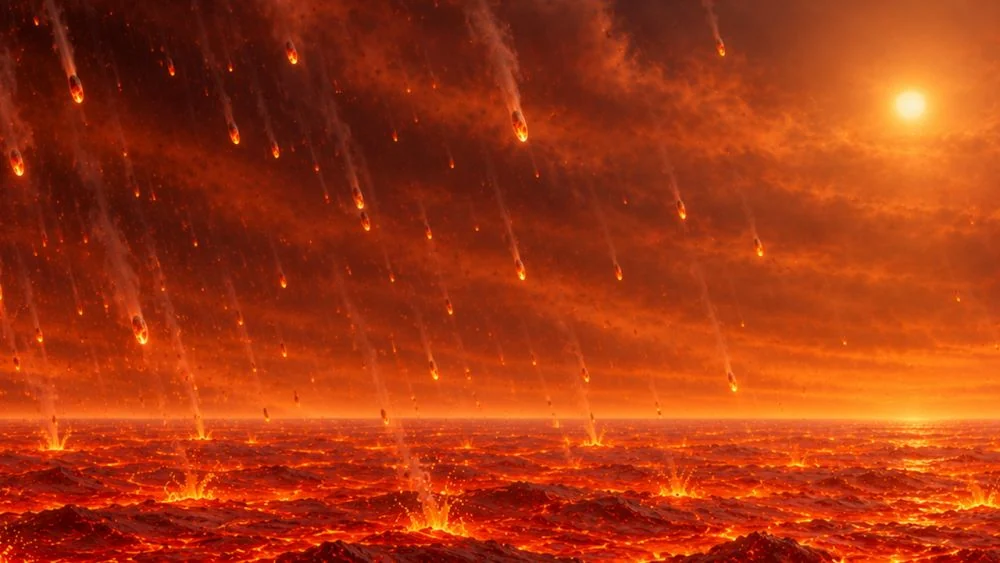
Researchers at the University of New Mexico propose that Earth's water formed internally during the planet's early development, rather than arriving via comets and asteroids. The study, published in Nature Geoscience, shows experimentally how water could have been produced when molten silicate pebbles fell through Earth's hydrogen-rich atmosphere billions of years ago.
Lead author Susmita Garai, a graduate student in Earth and Planetary Sciences at UNM, and co-author Zachary Sharp, professor and director of Earth and Planetary Sciences at UNM, heated silicate rock samples to between 1,200 and 1,400 degrees Celsius in streams of hydrogen. The experiments lasted 15 minutes to three hours and mimicked conditions when Earth was massive enough to attract falling pebbles and maintain a superheated, hydrogen-rich atmosphere.
In hydrogen streams, nearly 80 percent of iron oxide converted to metallic iron, producing water vapor. The same reaction did not occur in helium streams. The researchers calculated that this reduction process could have generated hundreds of ocean masses of water from pebbles with certain compositions.
The external delivery hypothesis faces timeline constraints involving the giant impact that created the Moon, the Late Heavy Bombardment, and mantle element abundances. Internal water generation sidesteps those constraints. "Virtually any Earth-sized planet should have water by this newly identified mechanism," Sharp said in a press release.
The dramatic scenario involves early Earth as a molten ball with molten pebble rain falling through a hellish atmosphere. Gravitational potential energy from settling pebbles heated the atmosphere to exceed 3,000 K and 200 bars of pressure. Sharp noted the findings may also apply to other worlds, including Mars.