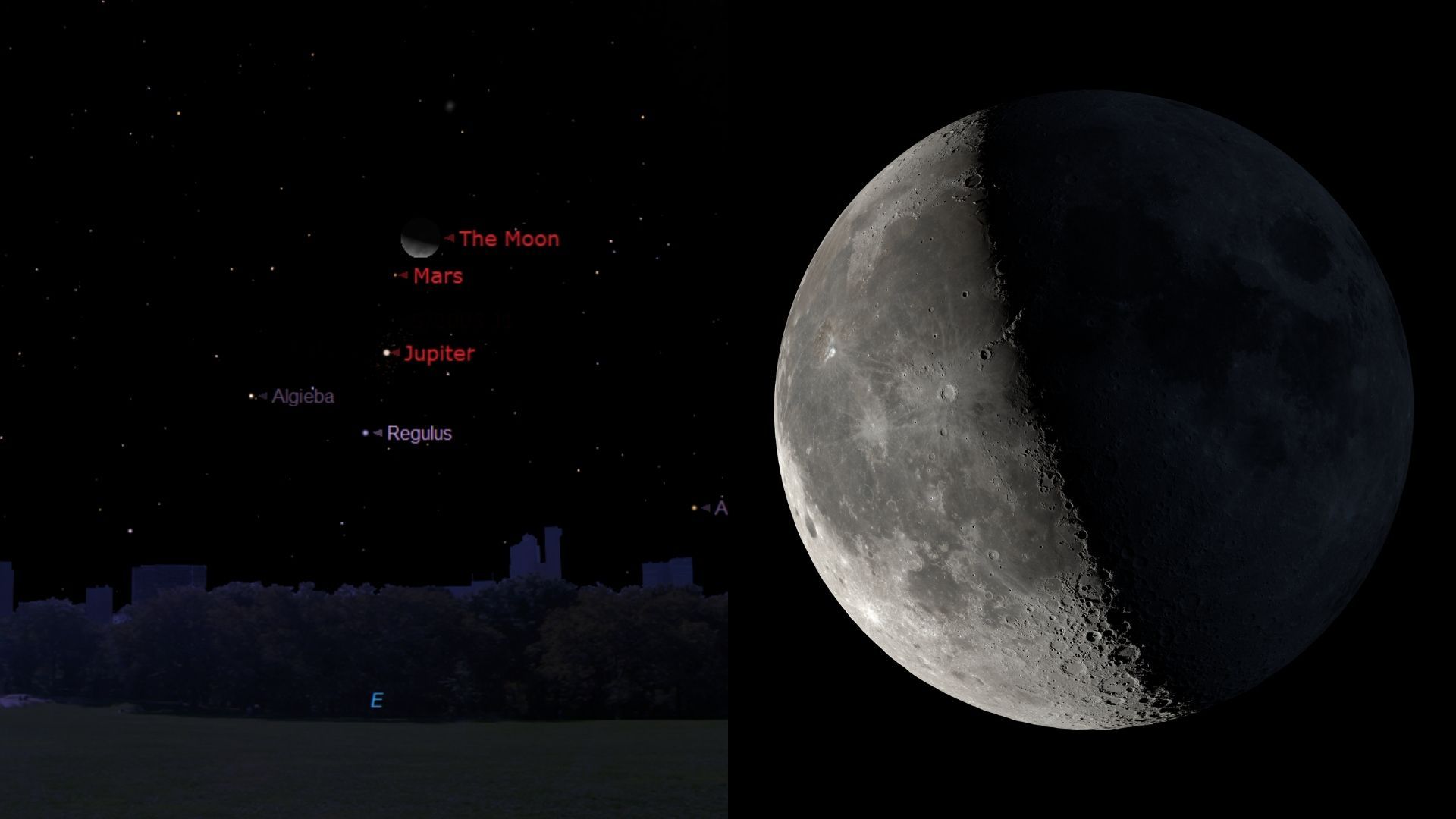
The moon passes within 5 degrees of Mars on the night of November 1-2, with Jupiter positioned just below the red planet and the star Regulus forming a line toward the horizon. Observers should look toward the eastern horizon about an hour after midnight to see the 45%-lit waning moon in this alignment. The Beehive Cluster (M44) will be visible roughly 10 degrees from the unlit side of the lunar disk, located in the constellation Cancer.
In parts of Australia, Indonesia, and several island nations and territories, the moon will pass directly in front of Jupiter in an occultation beginning at 3:45 p.m. EST on November 2, according to In-The-Sky.org. The exact visibility and timing depend on location.
By November 3, the lunar crescent will have moved past Jupiter and Mars to appear about 1 degree from Regulus. Observers in Brazil, Peru, Argentina, Bolivia, and Chile will witness the moon occult Regulus, with the event beginning at 7:01 GMT in Brazil and 7:15 GMT in Argentina on November 3.
The alignment illustrates the scale differences among celestial bodies. The moon appears largest from Earth's perspective but has less than half the diameter of Mars. Jupiter is over 20 times wider than Mars. The star Regulus is up to four times larger than the sun and could contain all the planets of the solar system within its expanse.