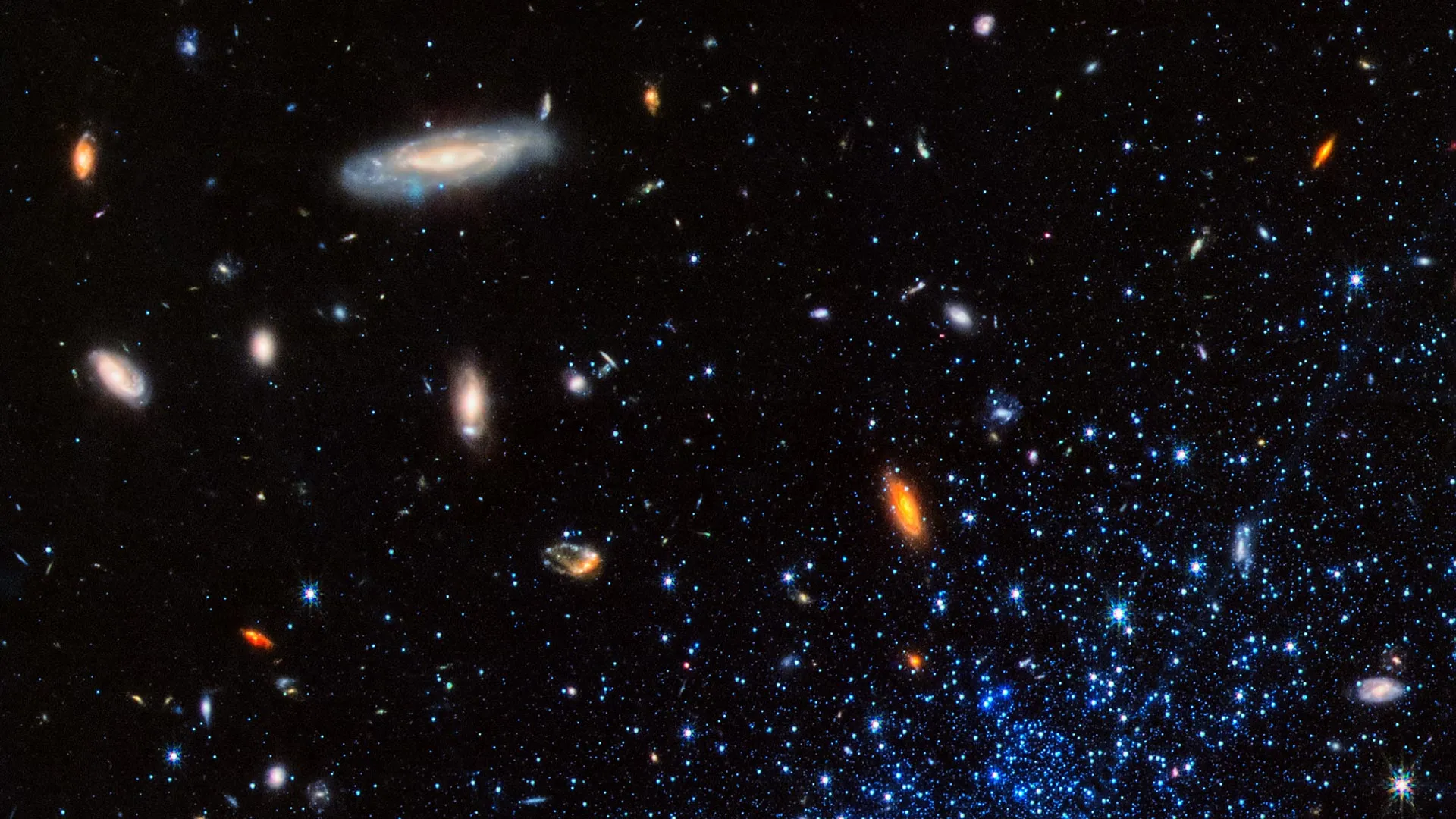
Researchers measured the amount of helium produced during the Universe's first five minutes with 0.5% uncertainty, three times more precise than previous estimates. An international team including scientists from the University of Minnesota Twin Cities published five papers in The Astrophysical Journal based on 130 hours of observations using the Large Binocular Telescope.
The team studied 15 distant, chemically pristine galaxies to determine primordial helium abundance. They used MODS spectrographs developed at Ohio State University to examine over 10 helium spectral lines and 15 hydrogen lines simultaneously, allowing them to identify and correct subtle measurement errors that earlier studies overlooked.
"This is a physics experiment on a grand scale and one of the biggest findings in my entire 40-year career," said Evan Skillman, Distinguished Professor in the School of Physics and Astronomy at the University of Minnesota. "It's a fundamental number that tells us specifically about the conditions of our Universe in its first five minutes."
The improved measurement provides a test of the Standard Model of physics. Using the precise helium measurement, researchers calculated the number of neutrino families in the early Universe. Neutrinos are extremely light subatomic particles whose behavior plays an important role in understanding fundamental physics.
The collaboration included scientists from the University of Minnesota Twin Cities, Ohio State University, Gonzaga University, Northwestern University, The University of Texas at Austin, Indiana University, University of California Santa Cruz, University of Illinois, Universidad Nacional Autónoma de México, and TRIUMF.