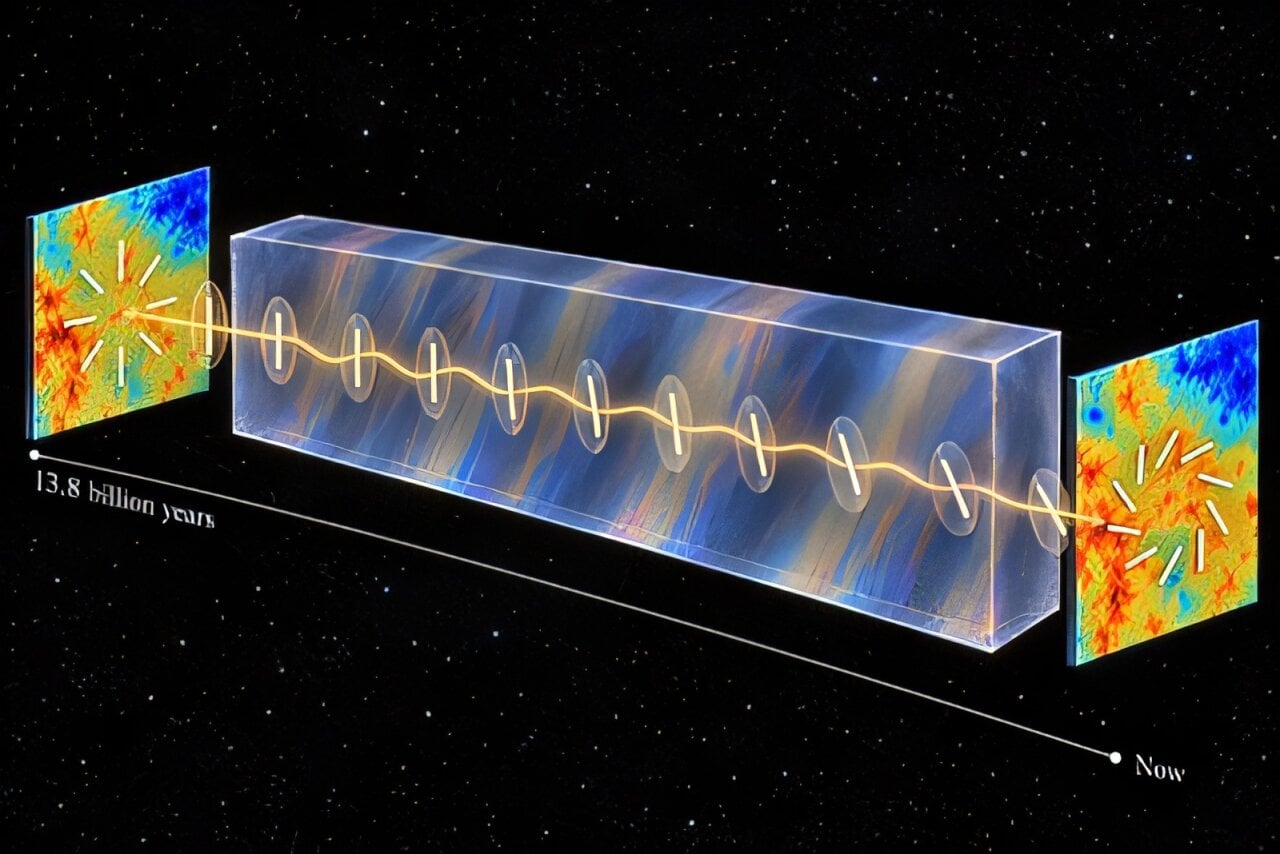
Astronomers have detected a subtle rotation in the polarization of the cosmic microwave background, a finding that challenges the cosmological standard model's assumption that the universe is homogeneous in all directions.
The research examines cosmic birefringence, a phenomenon where light traveling through the early universe encounters a rotating polarization angle. This effect would occur if the universe contains an asymmetric distribution of matter or energy on the largest scales. The study analyzes the polarization of the cosmic microwave background, the ancient light released roughly 380,000 years after the Big Bang that now permeates all of space.
Researchers looked for a rotation of E-modes, the primary polarization pattern in the cosmic microwave background, converting them into B-modes. These rotated patterns would indicate that space itself possesses a preferred direction or axis, violating the cosmological principle that underpins modern understanding of the cosmos. The cosmological principle assumes the universe appears the same from any vantage point and in any direction.
The team's analysis of the polarization data reveals evidence of this polarization bias at a level approaching statistical significance. This result aligns with an earlier independent study that also found anomalies in the CMB's polarization patterns. Two separate investigations reaching similar conclusions strengthens the case that something genuinely odd may persist in the ancient light.
If confirmed through additional observations, cosmic birefringence would represent a major discovery. It would suggest the universe contains hidden structures or fields that create preferred directions across billions of light-years. Some theoretical frameworks propose axion-like particles, hypothetical bosons that interact with photons, could produce exactly this effect. These particles remain candidates for dark matter, the invisible substance comprising 85 percent of the universe's matter content.
The implications extend beyond cosmology into fundamental physics. Standard particle physics relies on symmetries, including rotational symmetry at cosmic scales. Evidence for systematic polarization rotation would point toward new physics operating at energies far beyond current laboratory experiments.
Future observations will prove decisive. The Planck satellite and WMAP have provided the polarization data for these analyses, but next-generation CMB experiments promise dramatically improved sensitivity. Projects including CMB-S4 and other ground-based observatories will map the cosmic microwave background with unprecedented precision. These facilities will either confirm the polarization bias as a real feature of the universe or reveal it as a statistical fluctuation in the data.
The stakes run high for cosmology. A detection of cosmic birefringence would overturn decades of assumptions about cosmic homogeneity and isotropy. It would open entirely new research directions into the nature of dark matter, the universe's fundamental fields, and the large-scale structure of spacetime itself. Conversely, null results from improved experiments would reinforce the robustness of the standard model despite these tantalizing hints.