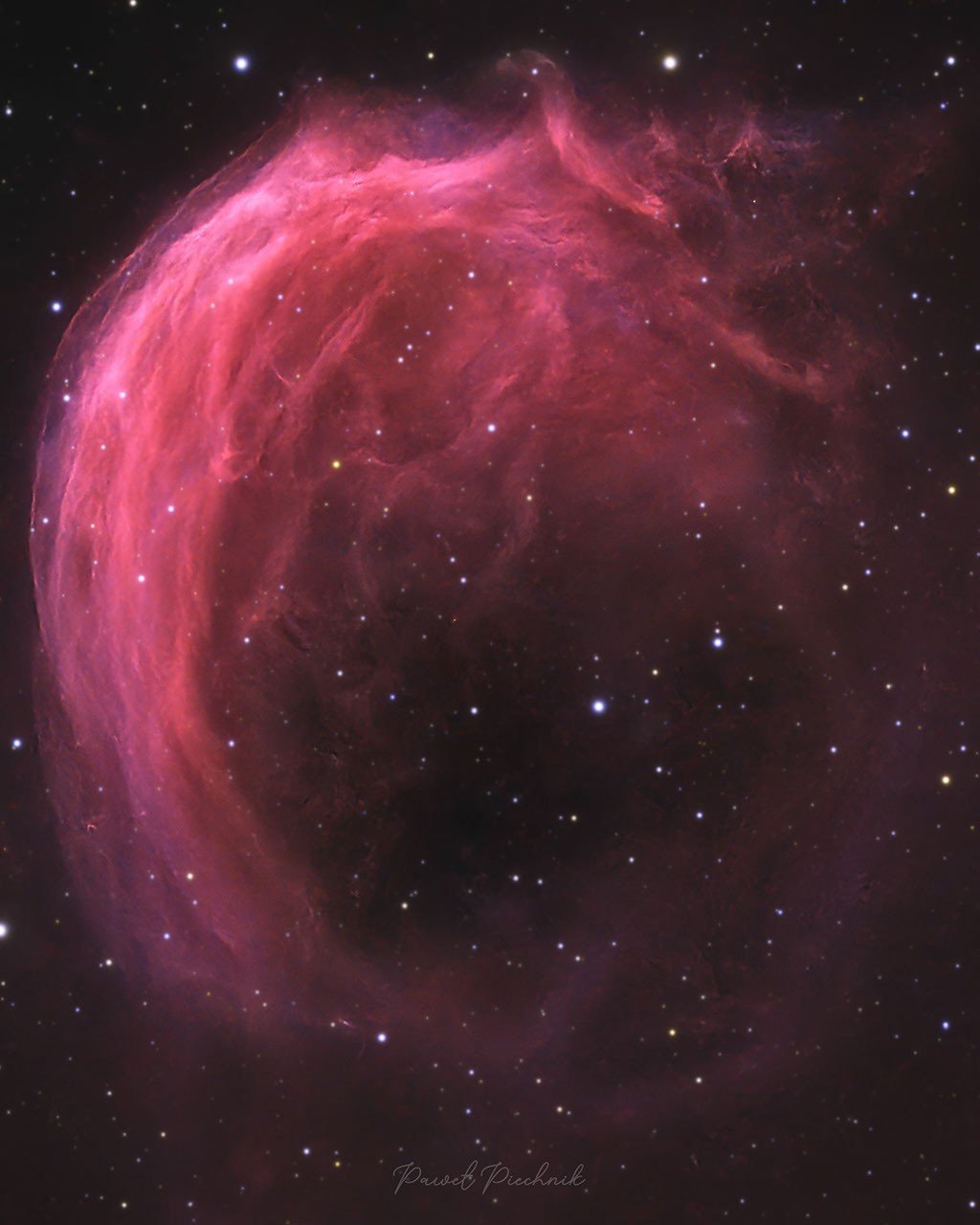
# Sh2-188: The Shrimp Nebula Reveals Hidden Star Formation in Infrared Light
NASA's Astronomy Picture of the Day featured Sh2-188, a faint emission nebula catalogued by astronomer Stewart Sharpless in 1959. The object earned its nickname, the Shrimp Nebula, from its curved shape that resembles a crustacean when viewed through powerful telescopes. Located roughly 1,500 light-years from Earth, this stellar nursery sits in the constellation Cassiopeia and represents one of the galaxy's vast repositories of ionized hydrogen gas.
Emission nebulae like Sh2-188 glow because ultraviolet radiation from young, massive stars strips electrons from hydrogen atoms. The recombination of these electrons with bare protons produces the characteristic red light that dominates visible-wavelength observations. Despite this optical glow, Sh2-188 remains relatively obscure compared to famous nebulae like the Orion Nebula or the Crab Nebula. Its faintness and remote location in the northern sky limit accessibility for ground-based amateur astronomers, yet space-based observatories reveal its true complexity.
The structure within Sh2-188 speaks to active star formation. Young stellar objects embedded within the nebula's dense molecular clouds continue to accumulate mass from their surroundings. Shocks and outflows from these protostars carve cavities into the nebula, creating the asymmetrical morphology that gives the object its shrimp-like appearance. Infrared telescopes penetrate the dust that obscures visible light, exposing the hottest regions where ionization occurs and newborn stars gather energy before ignition.
The Sharpless catalogue, completed in 1959, documented over 300 emission nebulae visible in hydrogen-alpha wavelengths. Sharpless used photographic plates from the Palomar Observatory and other facilities to systematically map these regions across the northern sky. His work established a foundational reference for nebular studies that persists today. Sh2-188 represents one entry in this comprehensive inventory of the Milky Way's stellar nurseries.
Understanding objects like Sh2-188 informs our broader knowledge of star and planet formation. The physical processes occurring within this nebula, replicated across billions of similar objects throughout the universe, shaped the creation of our own solar system 4.6 billion years ago. By observing how gravity compresses gas clouds, how radiation ionizes surrounding material, and how magnetic fields regulate collapse, astronomers reconstruct the conditions that produced the Sun and planets.
Modern infrared surveys from facilities including the Spitzer Space Telescope and the James Webb Space Telescope have revolutionized nebular science. These instruments detect thermal radiation from dust grains and reveal populations of low-mass protostars invisible to optical telescopes. Sh2-188 continues to yield discoveries as new observations accumulate. The nebula serves as a natural laboratory where the fundamental physics of stellar astrophysics operates openly, accessible to direct observation.