# The Ghostly Remnants of Five Supernovas Reveal the Violent Deaths of Ancient Stars
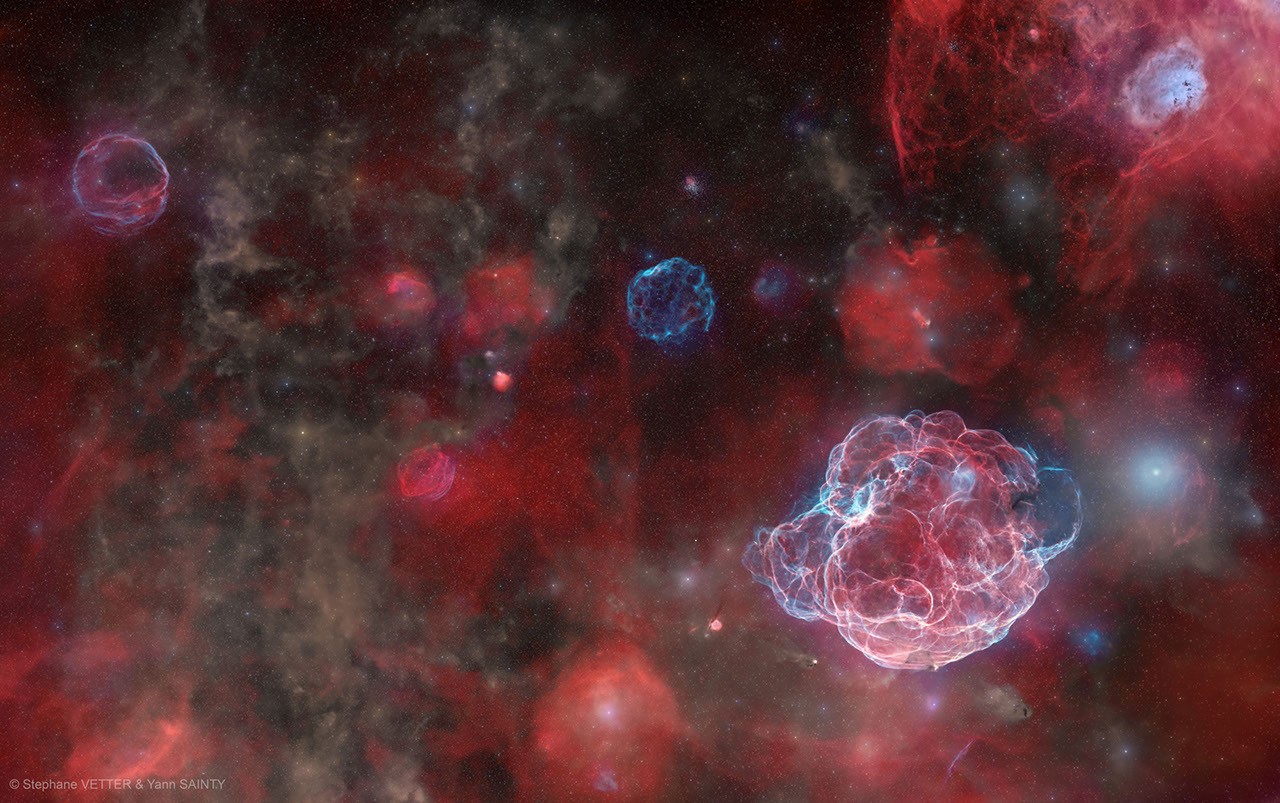
NASA's Astronomy Picture of the Day featured an image capturing the ethereal shells and filaments left behind by five separate supernova explosions, remnants that persist thousands of years after the catastrophic events that created them. These glowing structures, sometimes called supernova ghosts, represent the expanding shock waves and heated material ejected when massive stars reached the end of their lives and detonated.
Supernova remnants offer astronomers a window into stellar death and the mechanisms that scatter heavy elements across galaxies. When a star exhausts its nuclear fuel or a white dwarf accretes matter from a companion star, the resulting explosion occurs with tremendous violence. Material rushes outward at speeds exceeding 10,000 kilometers per second. This expanding debris heats surrounding gas and generates radiation that we observe across multiple wavelengths, from radio through X-rays.
The five supernovas captured in this observation existed at different stages of evolution. Some remnants appear as nearly complete shells or bubbles, smooth structures where the shock wave has swept through relatively uniform ambient material. Others display filamentary structures, thread-like features that trace the boundaries where hot gas meets cooler interstellar clouds. These variations depend on the age of each remnant, the properties of the local environment, and the type of supernova event that created them.
Type Ia supernovas occur in binary star systems where a white dwarf strips material from a companion and accumulates mass until a thermonuclear explosion occurs. Type II supernovas result from core collapse in massive stars, events triggered when iron cores become unstable. The mechanics differ, but both produce expanding remnants that continue evolving for tens of thousands of years.
Studying multiple remnants in a single field provides comparative data. Astronomers measure the expansion rates, determine ages by comparing current sizes against historical observations, and analyze the elemental composition of ejected material. These measurements refine our understanding of stellar explosion physics and how different supernova types distribute elements like iron, nickel, silicon, and oxygen throughout galaxies.
Supernova remnants also accelerate cosmic rays, those high-energy particles that permeate space. The shock fronts created by expanding remnants can energize particles to relativistic speeds. Understanding this acceleration process helps explain cosmic ray origins and their role in galactic chemistry and star formation.
The remnants visible in this image contribute to the interstellar medium from which new stars eventually form. The heavy elements forged in stellar cores, released only through supernova explosions, become incorporated into new stellar systems and planetary disks. Every atom of iron, oxygen, or silicon in terrestrial planets originated in stellar furnaces and traveled through space via supernova remnants like those shown here.
Observations of these five supernovas continue to generate data that constrains theoretical models of explosion mechanisms and remnant evolution. Ground-based telescopes and space observatories monitor these structures across the electromagnetic spectrum, building an increasingly detailed picture of how stellar death shapes galaxies.