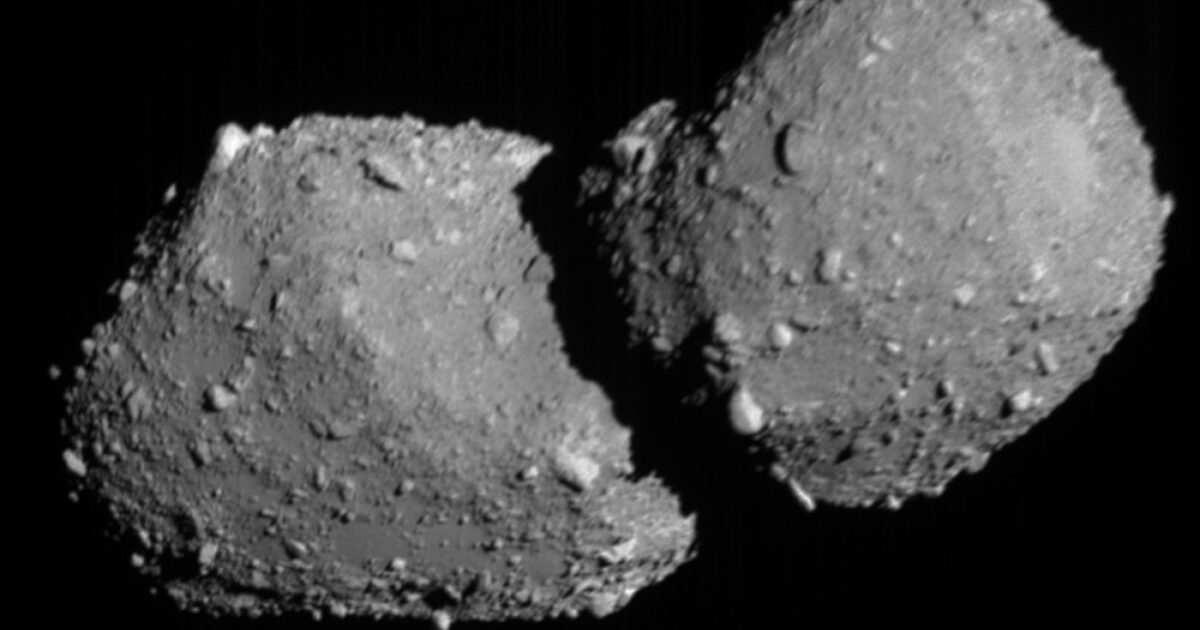
# Japan and China's Asteroid Missions Achieve Historic Close Encounters
Japan's Hayabusa2 spacecraft and China's Tianwen-2 orbiter have achieved unprecedented proximity observations of two separate asteroids, advancing humanity's understanding of these ancient solar system remnants and demonstrating the technical sophistication of both nations' deep space programs.
Hayabusa2, operated by the Japan Aerospace Exploration Agency (JAXA), conducted detailed reconnaissance of its target asteroid after completing its primary science objectives. The mission moved into an extended phase of operations, bringing the spacecraft into close orbital proximity with the asteroid to gather high-resolution imagery and spectroscopic data. These observations reveal asteroid geology at scales previously inaccessible to ground-based telescopes, capturing surface textures, composition variations, and structural features that inform models of how asteroids form and evolve.
China's Tianwen-2 spacecraft, meanwhile, executed its own close approach to a different asteroid target. The mission represents China's growing capability in planetary exploration and asteroid science. Tianwen-2 deployed advanced instruments to map the asteroid's surface and collect data on its physical properties, contributing to the international scientific database on small bodies.
Both missions employ similar strategies for close-range asteroid study. Spacecraft orbit at extremely low altitudes relative to their targets, sometimes just kilometers above the surface. At these distances, gravitational forces are minimal, requiring precise navigation to maintain stable positioning. Scientists coordinate observations to capture multiple angles of the same geological features, building three-dimensional models of asteroid structure.
The data collected serves practical and scientific purposes. Understanding asteroid composition helps scientists predict how these objects might respond to impact if humanity ever needed to deflect one on a collision course with Earth. The work also illuminates the early solar system's history. Asteroids preserve pristine material from 4.6 billion years ago, before planets formed. Studying them provides clues about the chemical building blocks from which Earth and other worlds assembled.
Hayabusa2 earned its reputation through an earlier successful sample-return mission to asteroid Ryugu. That operation collected dust and rock samples that returned to Earth and now sit in laboratories worldwide. The extended mission phase represents efficient use of remaining spacecraft fuel and operational capability, continuing to extract scientific value years after the primary mission concluded.
Tianwen-2 builds on China's track record in asteroid research and sample-return operations. The mission demonstrates that China's deep space exploration infrastructure now functions at competitive levels with established space agencies. The orbiter carries instruments designed to characterize asteroid mineralogy and document surface features at high resolution.
These close encounters generate data that drives multiple research fields. Planetary scientists use the observations to refine formation models. Engineers studying planetary defense scenarios incorporate detailed asteroid shape and density information into impact simulation software. Researchers planning future crewed deep space missions study asteroid regolith composition to assess resource utilization possibilities.
The coordinated achievements by JAXA and China's space program underscore a broader pattern in space exploration. While space agencies maintain distinct national programs and objectives, their work collectively builds knowledge that benefits all humanity. Each mission adds specificity to the scientific record, replacing assumptions with empirical data about objects that inhabit the space between Mars and Jupiter.