# Portraits of the Red Planet: How Viking 1 and Psyche Show Us Mars
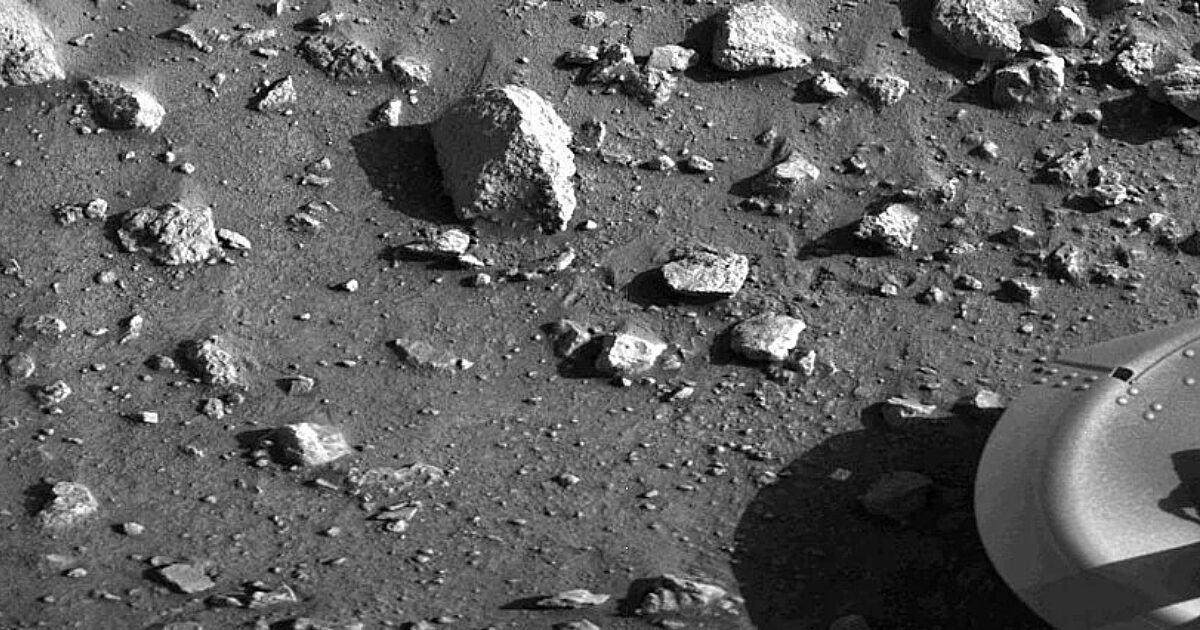
Mars reveals itself in layers. The Viking 1 lander, which touched down on the Martian surface on July 20, 1976, transmitted the first close-up images of rusty soil, scattered rocks, and a butterscotch sky. Nearly five decades later, the Psyche spacecraft carries cameras that image Mars differently, capturing the planet during gravity assists that propel the mission toward its namesake metallic asteroid in the main belt.
These twin perspectives, separated by generations of technology and orbital geometry, demonstrate how Mars appears radically different depending on vantage point and instrument capability.
Viking 1 operated from the Chryse Planitia basin in the northern hemisphere, an ancient riverbed selected for its geology and safety for landing. The spacecraft deployed two instruments designed to search for microbial life: the Gas Chromatograph Mass Spectrometer and the Labeled Release Experiment. Neither found conclusive evidence of life, but Viking 1's cameras documented a world of geological complexity. The ochre landscape, punctuated by rocks and drifts of iron oxide-rich dust, established Mars as a real place, not an abstract point of light in Earth's sky.
Psyche's Mars imagery serves a different purpose. The mission, launched by NASA in October 2023, uses Mars as a stepping stone in its trajectory toward the asteroid Psyche. During these gravity assists, instruments aboard the spacecraft, including high-resolution cameras, capture images that serve dual roles: they validate spacecraft health and provide a modern comparison to Viking-era observations. Psyche's optics reveal surface features with resolution that Viking never achieved, showing impact craters, layered terrain, and evidence of water erosion with unprecedented clarity.
The contrast between these two eras reflects the evolution of planetary exploration. Viking 1 required a direct trajectory to Mars, a journey lasting months with uncertain outcome. Psyche takes a longer path, using gravitational assists from Venus and Earth to gain velocity efficiently. This technique, standard in contemporary deep-space missions, allows for more ambitious destination selection. Where Viking 1 aimed for a single point, Psyche surveys broad regions while maintaining its course toward the asteroid belt.
For observers on Earth, Mars offers its own visual spectacle. The planet appears brightest during opposition, when Earth passes between the Sun and Mars. At these moments, Mars blazes orange-red in the night sky, bright enough to dominate constellations it inhabits. Binoculars reveal the polar ice caps during opposition. Telescopes show surface albedo features, the light and dark regions caused by dust distribution and mineral composition. The Great Red Spot analogs and Syrtis Major region have remained recognizable to observers for centuries.
The three perspectives—Viking 1's ground-truth imagery, Psyche's modern remote sensing, and human observation from Earth—comprise a complete portrait. Each reveals Mars at a different scale and temporal cadence. Viking 1 showed us Mars as a place where rovers could operate and cameras could document. Psyche demonstrates that Mars remains scientifically relevant beyond life-search missions, serving as both a subject of study and a gravitational staging point for asteroid exploration. Earth-based observation keeps Mars present in human consciousness, a visible reminder that planets beyond our world await exploration.