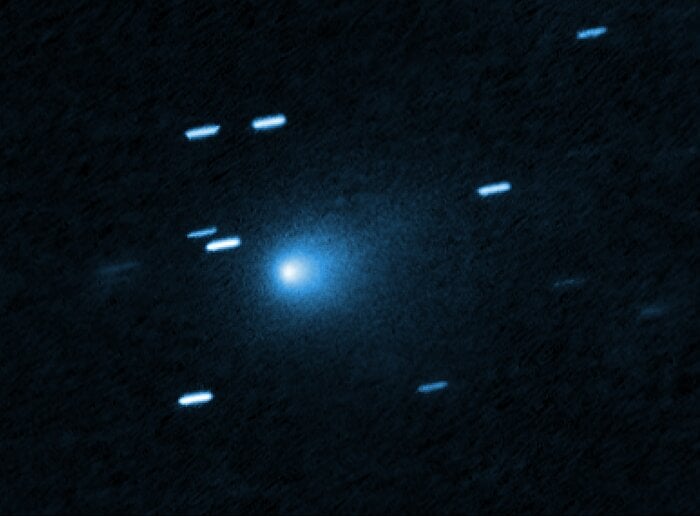
Astronomers have detected an unusual abundance of heavy water in the interstellar comet 3I/ATLAS, revealing a chemical signature that differs markedly from comets born within our solar system. The discovery, detailed in a paper submitted to The Astrophysical Journal Letters, provides a direct window into the chemical composition of another star system and challenges assumptions about how water isotopes distribute across the galaxy.
3I/ATLAS was discovered in July 2025 and represents only the third confirmed interstellar visitor to pass through our solar system. The first two were 1I/Oumuamua in 2017 and 2I/Borisov in 2019. When powerful space telescopes including the Hubble Space Telescope turned their instruments toward the newcomer, they detected an enriched ratio of deuterium to hydrogen, the signature of heavy water molecules. Deuterium is a stable isotope of hydrogen containing one neutron alongside its proton, making molecules containing it heavier than their standard counterparts.
The research team, led by Kenji Furuya of the RIKEN Pioneering Research Institute in Japan, found that 3I/ATLAS contains a higher proportion of heavy water than most comets formed in our own solar system. This compositional difference points to formation in a different chemical environment, likely around another star with different temperature and radiation conditions during the comet's origin.
The ratio of deuterium to hydrogen serves as a chemical fingerprint tracing a comet's birthplace. In our solar system, comets formed in the outer regions where temperatures were cold enough to preferentially trap heavier isotopes. The elevated heavy water content in 3I/ATLAS suggests it coalesced under distinct physical conditions, perhaps in a denser cloud or closer to the ultraviolet radiation from a different star. These factors influence which isotopes freeze into ice and remain bound to forming cometary nuclei.
Understanding these isotopic variations matters because deuterium ratios encode information about the thermal history and radiation environment of protoplanetary disks around other stars. When 3I/ATLAS passed through our solar system, it delivered a sample of material from another star's planetary formation region, something impossible to obtain through any other means. Remote spectroscopy from Earth-based telescopes cannot distinguish individual molecules with the precision needed to measure deuterium enrichment.
The discovery also raises questions about whether interstellar comets preserve the chemical conditions of their native systems or if they undergo chemical processing during the journey through interstellar space. The apparent preservation of isotopic ratios suggests that comets survive the harsh radiation environment of interstellar space with their internal chemistry relatively intact.
As 3I/ATLAS continues its outbound trajectory, astronomers will continue analyzing data already collected. Future interstellar visitors will receive similar scrutiny. Each new arrival refines our understanding of how planetary systems form and what material floats freely between stars. The heavy water signature in 3I/ATLAS demonstrates that visiting interstellar comets function as genuine samples of distant planetary systems, carrying chemical evidence of processes that shaped worlds light-years away.