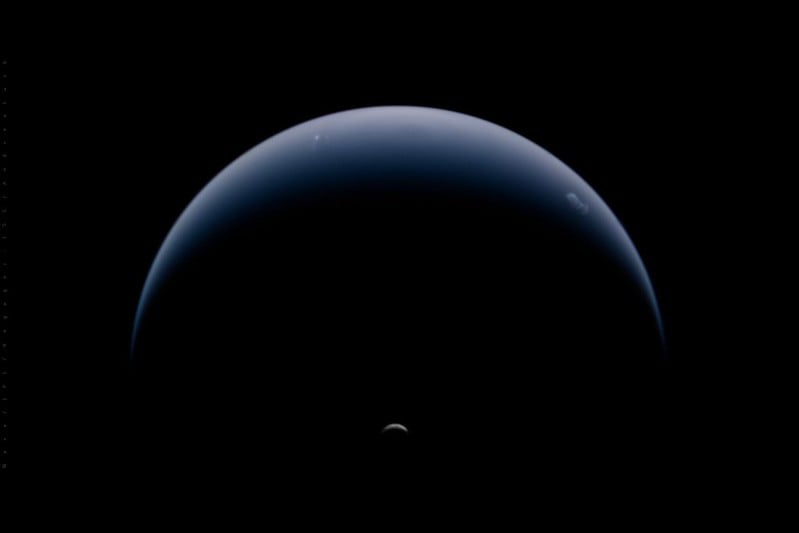
Neptune reaches opposition in late September 2026, positioning the ice giant for optimal viewing from Earth. The planet will rise as the Sun sets, climbing high in the southern sky toward midnight. This alignment occurs when Neptune sits directly opposite the Sun from Earth's perspective, placing the planet fully illuminated and at its closest approach to us in its 165-year orbit.
Opposition events happen once per year for outer planets. Neptune's slow orbital mechanics mean the event occurs roughly every 367 days. The 2026 opposition delivers the planet's best visibility window for ground-based observers for the entire year. Telescope and binocular users can spot the ice giant as a faint blue-green dot, though the planet never brightens enough for naked-eye observation from most locations on Earth.
Neptune orbits the Sun at an average distance of 30 astronomical units, roughly thirty times farther than Earth. This extreme distance explains why the planet remains invisible to the unaided human eye. At opposition, Neptune sits approximately 29 AU from Earth. Even at this closest point in its orbit, the ice giant receives only faint sunlight compared to inner solar system worlds.
The planet last reached opposition in September 2025. Its next opposition after 2026 arrives in September 2027. This predictable cycle follows directly from the planet's orbital period and Earth's faster motion around the Sun. Astronomers can calculate opposition dates centuries into the future with high precision.
Neptune holds scientific interest beyond its visual appeal. The planet's atmosphere contains supersonic winds exceeding 2,100 kilometers per hour, making it the windiest world in the solar system. The Great Dark Spot, a storm system observed during Voyager 2's 1989 flyby, rivaled Jupiter's Great Red Spot in scale before mysteriously vanishing by the mid-1990s. Repeated observations during opposition windows have tracked atmospheric changes and cloud formations.
The Voyager 2 spacecraft provided humanity's only close-range views of Neptune during its encounter four decades ago. No mission has returned since. The ice giant remains one of the solar system's least explored worlds. Ground-based observations during opposition windows contribute to monitoring the planet's weather patterns and atmospheric composition until a future dedicated mission launches.
Amateur astronomers value opposition opportunities for serious observation programs. High-resolution telescopes with 200 millimeters of aperture or larger can reveal Neptune's disk and occasionally show cloud features. Digital imaging and video observation techniques allow amateurs to contribute data on planetary brightness, cloud movements, and potential atmospheric events.
The 2026 opposition occurs at a favorable time for Northern Hemisphere observers. Neptune's declination places it well above the celestial equator, positioning the ice giant high enough for lengthy observation sessions from mid-northern latitudes. Southern Hemisphere observers will find Neptune higher still, offering extended viewing windows.
Anyone planning to observe Neptune in 2026 should consult current star charts and astronomical software to pinpoint the exact location. The planet's slow motion across the background stars means it occupies the same constellation region for several years. Binocular star charts specifically marking Neptune's position simplify the search. Once located, follow-up observations throughout the opposition season reveal the planet's motion relative to background stars.