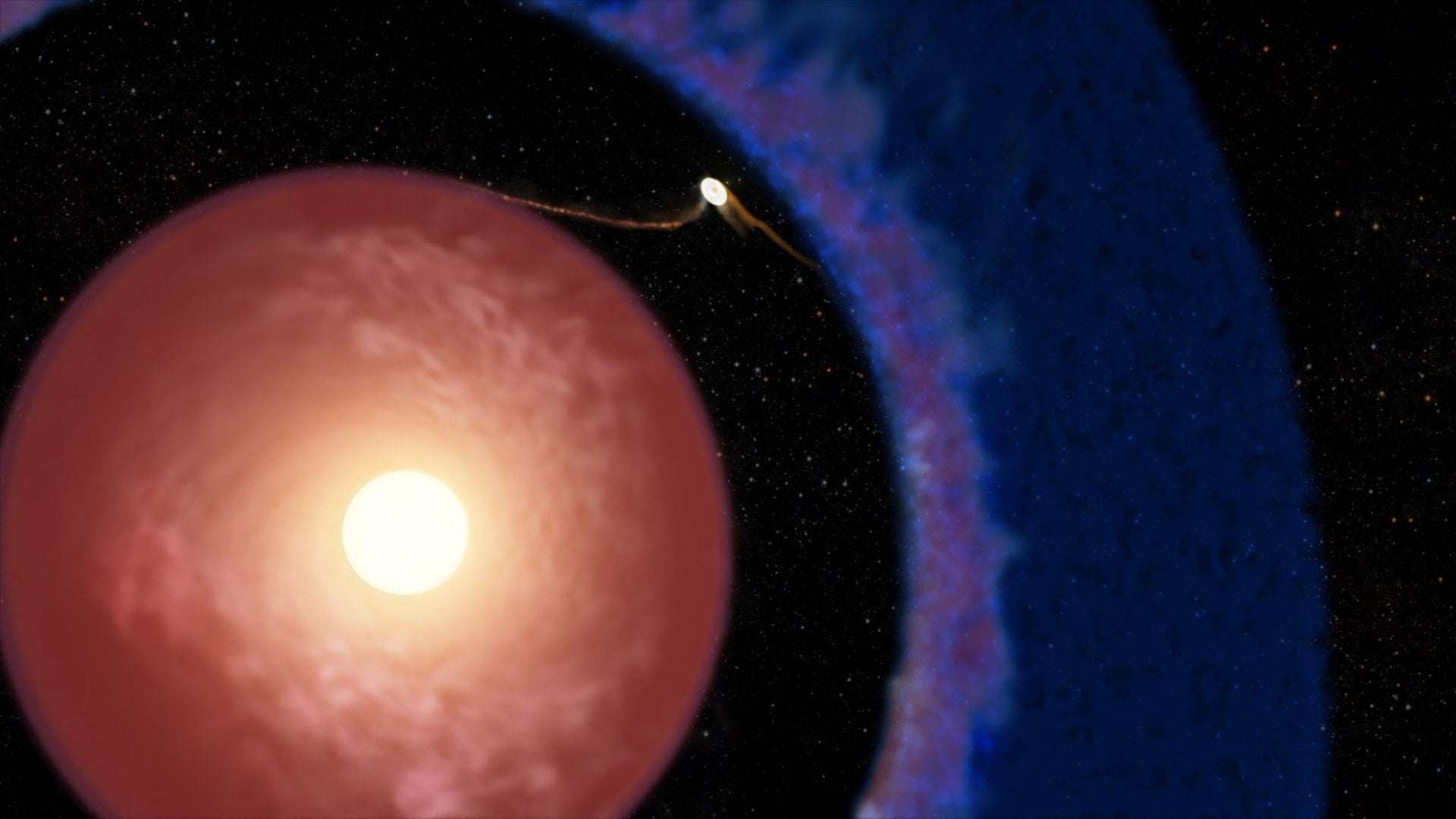
Astronomers have directly imaged the youngest exoplanet ever discovered, a world still forming around the star Elias 2-24 and estimated to be less than one million years old. The discovery, published in The Astrophysical Journal Letters by a team led by Andrea Bernardi at Diego Portales University in Chile, represents a watershed moment in planetary science. Direct imaging of planets orbiting other stars remains extraordinarily difficult, yet capturing one so early in its formation offers an unprecedented window into how planets grow.
Elias 2-24 sits roughly 435 light-years away in the constellation Ophiuchus. The star itself is young, perhaps just a few million years old, still surrounded by the protoplanetary disk of gas and dust from which planets form. Within this disk, astronomers detected a forming planet using the W.M. Keck Observatory in Hawaii. At less than one million years old, this world is a newborn compared to Jupiter, which took roughly 10 million years to reach its current mass, and Earth, which formed over 4.5 billion years ago.
The detection required sophisticated infrared imaging. Young planets are hot from the gravitational collapse that built them. They radiate thermal energy in the infrared spectrum, making them theoretically detectable even though they emit no visible light of their own. Keck's adaptive optics system, which corrects for atmospheric distortion in real time, enabled the team to distinguish the planetary signal from the overwhelming glare of its host star.
Most exoplanet discoveries rely on indirect methods. The transit technique tracks the slight dimming of starlight as a planet passes in front of its parent star. Radial velocity measurements detect the gravitational wobble a planet induces in its host star. These methods work for mature planets but struggle to capture planets still embedded in dusty disks. Direct imaging bypasses these limitations entirely, though it demands extreme technical precision and works best for young, massive planets orbiting distant stars.
The planet around Elias 2-24 likely ranks among the most massive young planets yet observed. Its formation poses interesting questions about planetary assembly. Astronomers debate two primary formation pathways. Core accretion theory proposes that planets build gradually as dust grains stick together, eventually growing massive enough to pull in gas atmospheres. Disk instability theory suggests that under certain conditions, a protoplanetary disk can become unstable and fragment directly into planets. The properties of this system may help constrain which process dominates in nature.
Subsequent observations will track this planet's evolution. As it continues aging, its infrared brightness will fade. Repeat imaging over months and years will reveal its orbital motion, allowing astronomers to calculate its mass and orbital characteristics more precisely. Spectroscopic analysis of the planet's infrared light may reveal atmospheric composition, potentially detecting water, methane, or other molecules still forming in this young world.
This discovery opens new avenues for studying planetary birth. Rather than inferring formation processes from the properties of mature planets, astronomers can now observe planets actively assembling. Each young system captured directly illuminates the physics of planetary construction. Future instruments like the Extremely Large Telescope and James Webb Space Telescope will amplify these capabilities, enabling surveys of younger planets around younger stars and transforming our understanding of how worlds arise.