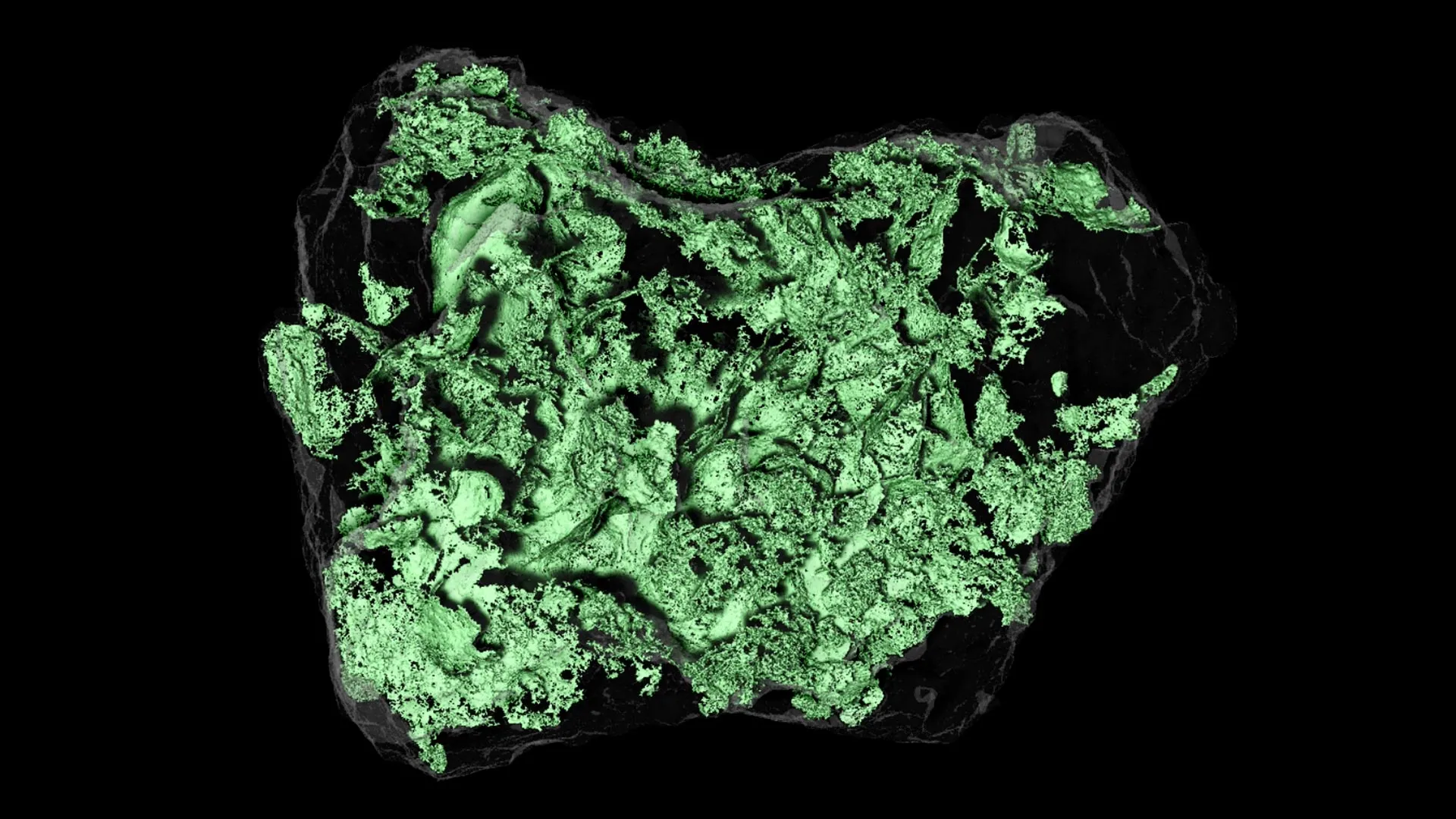
NASA's OSIRIS-REx mission discovered that asteroid Bennu's surface is dominated by enormous boulders rather than the smoother terrain earlier observations had suggested. This raised a puzzle: Bennu cooled rapidly between sunlight and darkness, a property called low thermal inertia, yet massive rocks typically retain heat longer than fine-grained materials.
Analysis of samples returned to Earth revealed the answer. Researchers found that Bennu's rocks are highly porous and contain extensive networks of internal cracks. These fractures allow heat to escape faster than solid rock would, explaining the asteroid's rapid cooling cycle.
Andrew Ryan of the University of Arizona led the study. "It turns out that they're really cracked too, and that was the missing piece of the puzzle," Ryan said.
Scientists used X-ray computed tomography at NASA's Johnson Space Center to scan individual rock particles in protective containers without exposing them to Earth's environment. The 3D scans revealed internal structures invisible from the surface. Computer simulations then tracked how heat moves through the cracked, porous material, scaling up from individual particles to the enormous boulders on Bennu's surface to reproduce the spacecraft's thermal observations.
Ron Ballouz at Johns Hopkins University Applied Physics Laboratory noted that the findings connect remote telescope measurements to actual asteroid material structure. "We can finally ground our understanding of telescope observations of the thermal properties of an asteroid through analyzing these samples from that very same asteroid," Ballouz said.
The work was published in Nature Communications and involved collaboration with Nagoya University in Japan and Japan's Hayabusa-2 mission.