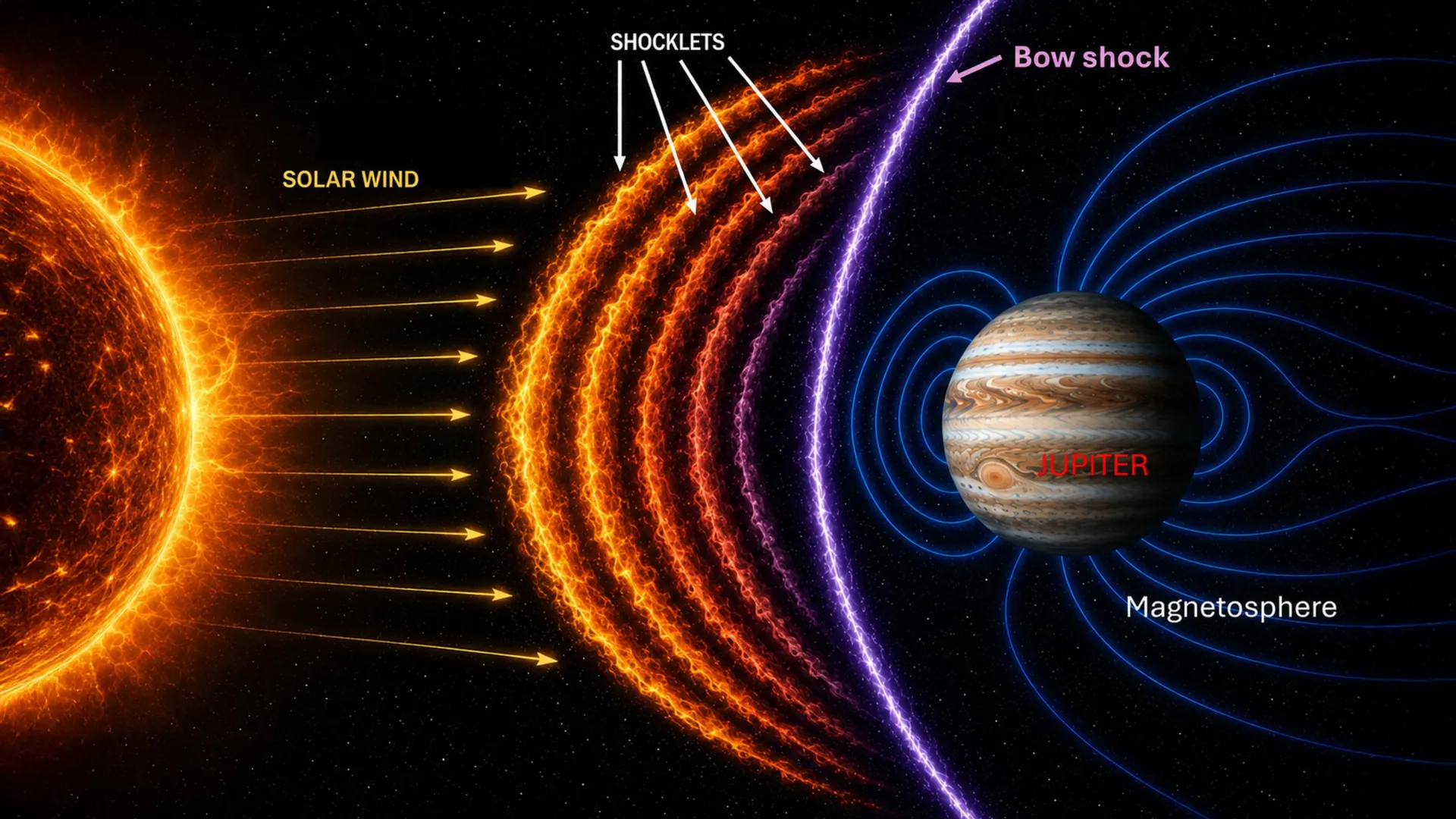
NASA's Juno spacecraft has revealed that Jupiter's bow shock, the boundary where solar wind particles encounter the planet's magnetic field, operates through a more complex system than Earth's protective shield.
Led by researchers at the University of Iowa, the study analyzed data collected by Juno in December 2024. The findings appear in Nature Communications.
Jupiter uses plasma waves with multiple frequency harmonics to slow and heat incoming solar particles. Earth's bow shock, by contrast, relies primarily on plasma waves concentrated around a single frequency. "Jupiter has found its own way to deal with the solar wind, through plasma waves that are stronger and exhibit richer harmonic structures," says Jayasri Joseph, the study's corresponding author. "That's important because if you have multiple frequencies, you can heat more particles in the solar wind and slow them down."
The research identified another difference. Before particles reach Jupiter's main bow shock, they encounter smaller shock structures called shocklets that slow the solar wind before it reaches the primary boundary. Earth's bow shock lacks these additional regions because the solar wind impact is less powerful there.
Bill Kurth, a research scientist at Iowa who has participated in Juno since its 2011 launch, notes the distinction reflects Jupiter's scale and magnetic strength.
The observations may illuminate shock waves throughout the universe. Supernova remnants produce far more extreme shock waves than those at Jupiter, but they operate through similar physical processes. "Because even more powerful shocks occur around astrophysical objects such as supernova remnants, Jupiter's bow shock offers a nearby natural laboratory for exploring and for understanding how nature converts enormous amounts of flow energy into heat and energetic particles," Joseph says.
Juno's Waves instrument, built by University of Iowa physicists, provided the measurements by detecting electric and magnetic wave activity around Jupiter.