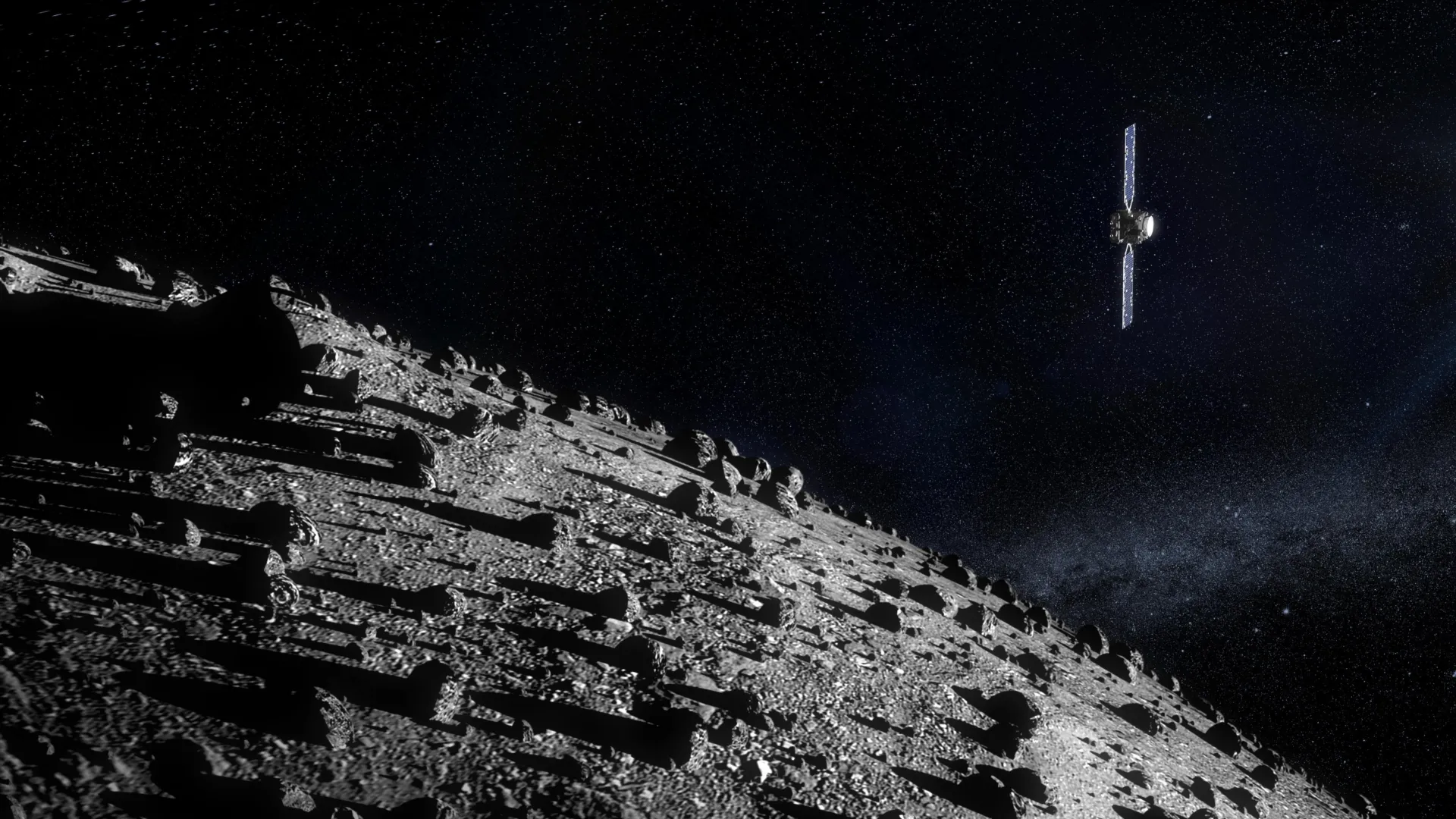
The European Space Agency's Hera spacecraft captured its first resolved image of the asteroid pair Didymos and Dimorphos as separate objects on October 18, from approximately 1,280 kilometers away. The smaller Dimorphos appeared as roughly one pixel in the image, clearly separated from its larger companion for the first time.
Hera is approaching the binary asteroid system to investigate the aftermath of NASA's Double Asteroid Redirection Test (DART), which deliberately struck Dimorphos on September 26, 2022, at roughly 6.1 kilometers per second. The impact ejected debris up to 10,000 kilometers into space and shortened Dimorphos's orbital period around Didymos by approximately 33 minutes.
The collision produced unexpected results. Computer simulations had predicted a smaller orbital change, raising questions about Dimorphos's physical properties and how it responded to the impact. Scientists do not yet know whether DART created a crater on Dimorphos, significantly altered its shape, or what the asteroid's composition, internal structure, and mass are.
Dimorphos measures about 151 meters across. Its companion Didymos reaches approximately 780 meters in diameter. Dimorphos orbits Didymos at an average separation of 1.15 kilometers at roughly 18 centimeters per second.
Hera completed two thruster maneuvers in October, spaced one week apart, reducing its approach speed to just 20 meters per second. The spacecraft will release two CubeSats to gather observations from closer distances and conduct detailed investigations including landing operations. ESA plans to release detailed images of Dimorphos on November 25.
"For the very first time we are seeing through Hera's own eyes the very double asteroid system that the mission was designed and built for," said mission manager Ian Carnelli.