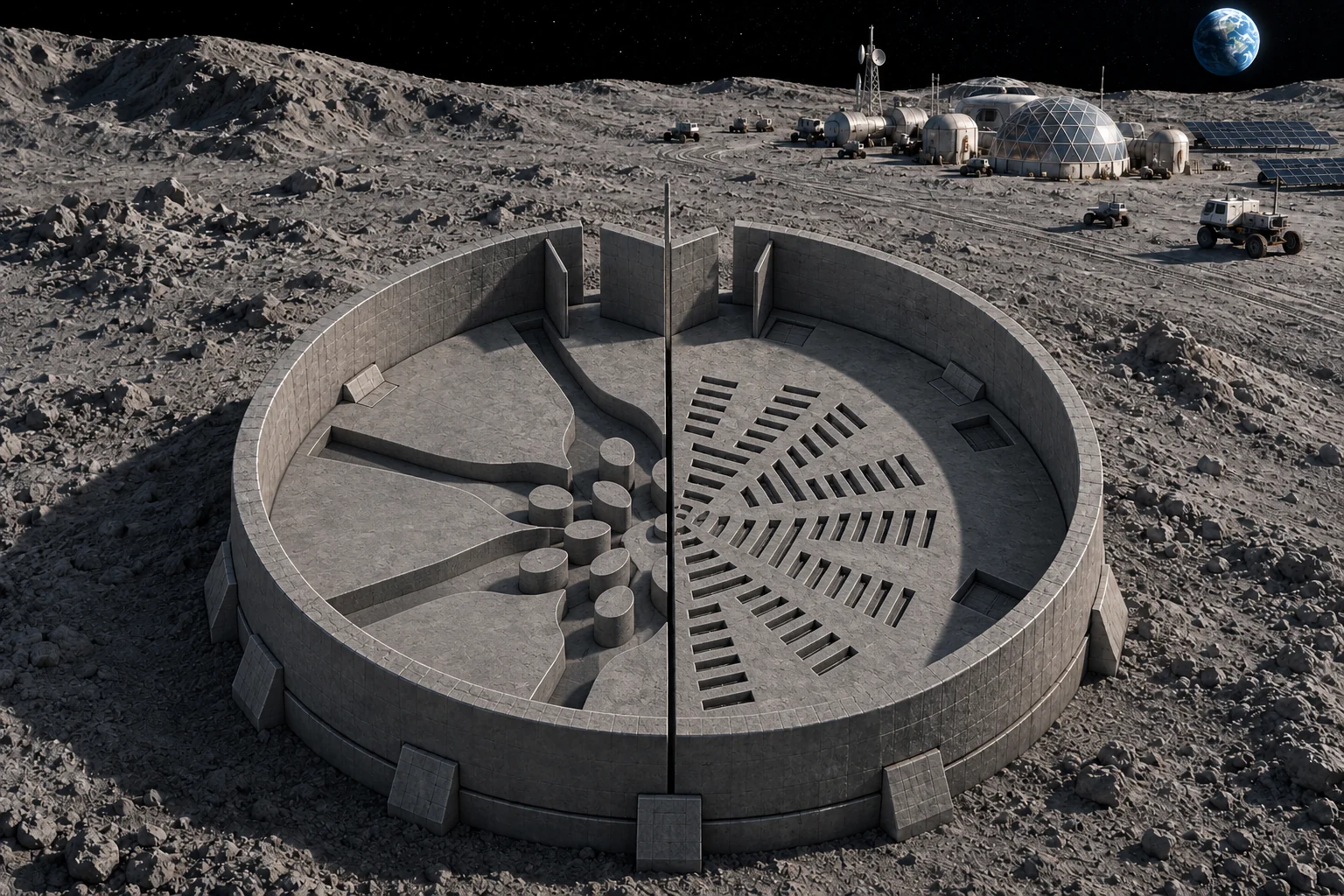
A team of engineering students from the University of Alabama in Huntsville has successfully tested a prototype landing pad designed to protect lunar spacecraft, astronauts, and infrastructure from rocket exhaust damage during vertical landings and takeoffs.
The pad prototype, measuring 3.65 meters in diameter, underwent three rocket-motor firing tests this summer at UAH's Propulsion Research Center. The tests demonstrated that the pad's integrated vent system could capture and redirect rocket exhaust, preventing thermal damage to the structure.
The design uses interlocking concrete components with internal channels that channel exhaust away from the pad and spacecraft. The concrete serves as an analog for materials that could be produced on the Moon from regolith through sintering into 3D-printed ceramics or by combining regolith with a bonding agent to create "lunacrete."
The research, led by Dr. Judy Schneider from UAH's Department of Mechanical and Aerospace Engineering, is part of a partnership with Linc Research Inc. and supported through NASA's Small Business Technology Transfer program. The work supports NASA's Artemis Program objectives for lunar infrastructure.
On Earth, water-cooled flame buckets redirect rocket exhaust. The Moon's airless environment presents a different challenge. Rocket plumes can propel dust at high speeds across vast distances, potentially damaging habitats, power systems, equipment, and orbiting satellites.
The modular design offers advantages for lunar construction. Smaller components are easier to assemble, expand, maintain, and repair. This approach also supports In-Situ Resource Utilization, or ISRU, by enabling use of local lunar materials for building infrastructure.
The team is now developing a 6-meter diameter landing pad for delivery to NASA's Marshall Space Flight Center for further testing and evaluation.