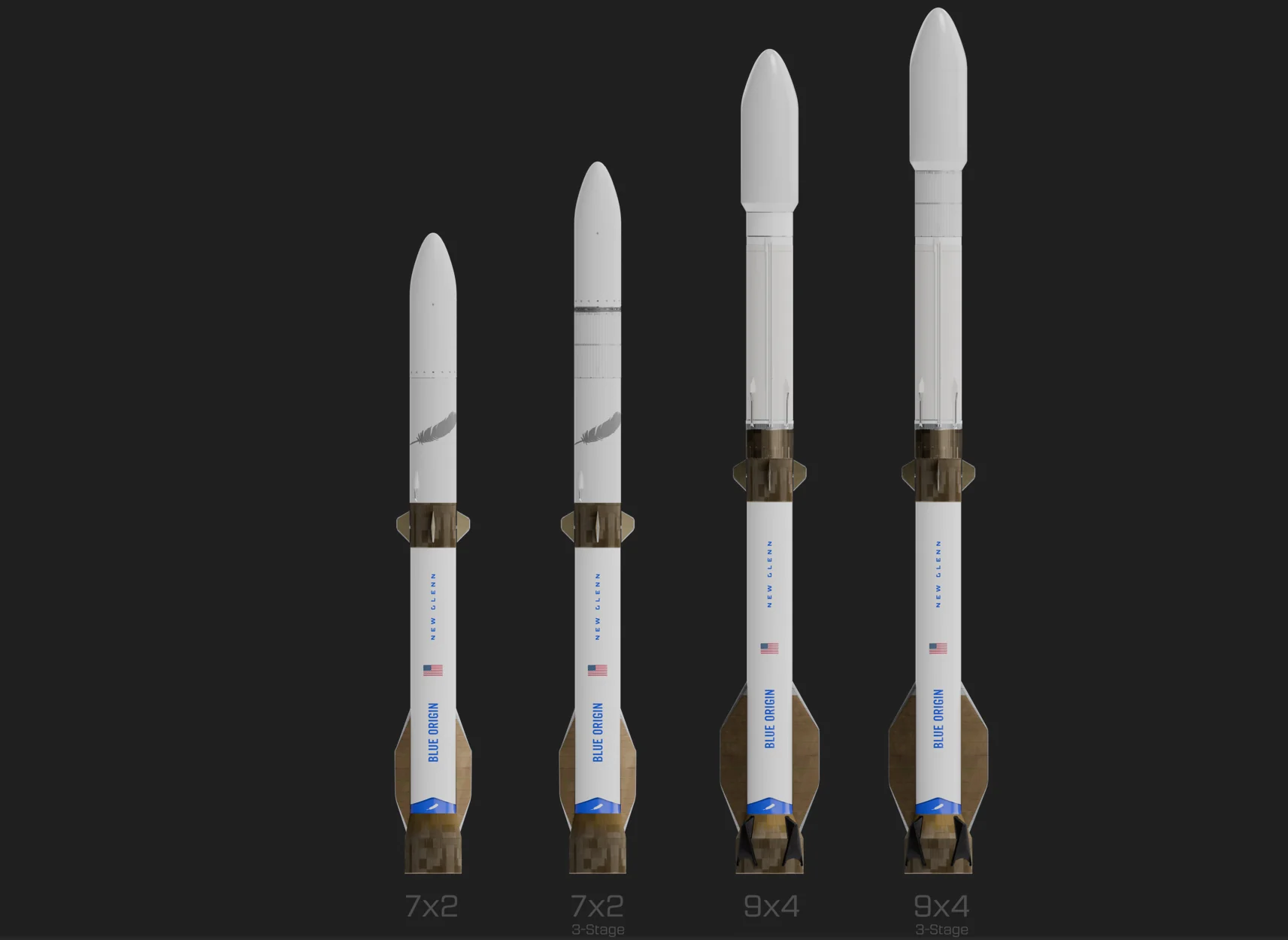
Blue Origin Chief Executive Dave Limp unveiled a third stage for New Glenn called GS3 and introduced a new booster engine named Northstar. The GS3 third stage targets direct injection to geostationary orbit and Earth-escape trajectories. The Northstar engine produces 715,000 pounds of thrust and runs on liquid oxygen and liquefied natural gas.
New Glenn has already flown twice as a two-stage vehicle, including the NG-1 debut with the Blue Ring Pathfinder and NG-2 carrying NASA's ESCAPADE mission. The NG-3 mission deployed AST SpaceMobile satellites. NG-4 was destroyed during a static fire attempt in May, but Blue Origin is preparing NG-4.1 with booster "Never Tell Me The Odds" for early 2027.
On the smaller 7x2 configuration, GS3 can deliver up to 8 metric tonnes to geostationary orbit and 10 metric tonnes to trans-lunar injection. On the larger 9x4 variant, those capabilities rise to 14 metric tonnes to geostationary orbit and 20 metric tonnes to trans-lunar injection. GS3 is already under contract for a cis-lunar mission with a government customer, scheduled to launch in 2028.
GS3 uses the same payload fairings and adapters as the two-stage New Glenn. The stage runs on Blue Origin's BE-7 engine, a liquid oxygen and liquid hydrogen engine that delivers vacuum specific impulse better than 460 seconds. At Launch Site One in Texas, teams completed the first composite liquid hydrogen tank test, pressurizing it to 100 percent of maximum expected operating pressure for 2.5 hours.
Northstar represents Blue Origin's second booster engine alongside the BE-4. More than 65 percent of Northstar is additively manufactured. Compared to BE-4, Northstar achieves a 30 percent mass reduction and a 50 percent cut in parts count while increasing thrust from 640,000 to 715,000 pounds-force. Blue Origin says Northstar final assembly now takes less than a day.