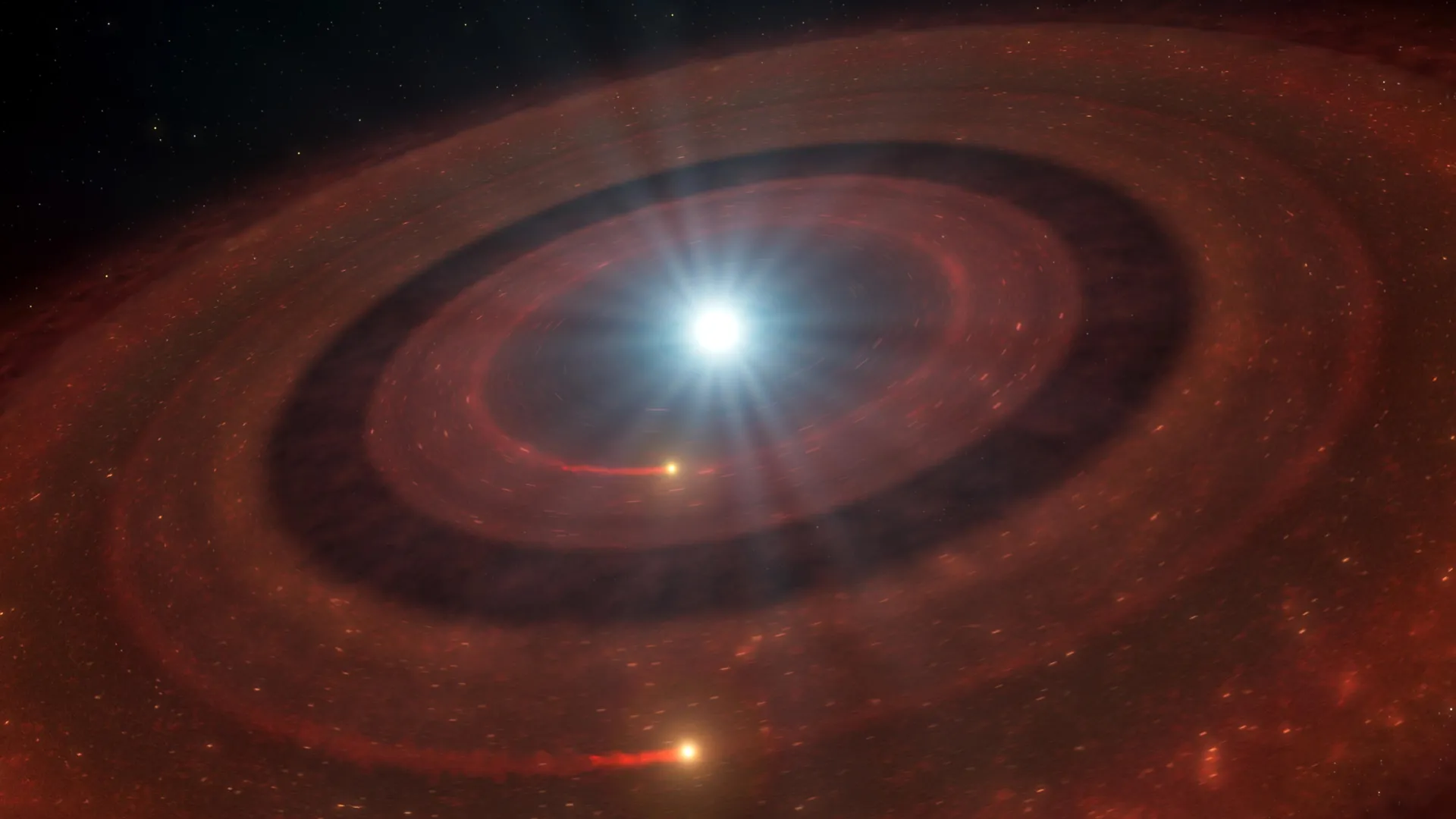
Astronomers using the European Southern Observatory's Very Large Telescope discovered a double ring of planetary debris around the white dwarf J1328-1450, a dead star that offers a glimpse of what may happen to our Solar System billions of years in the future.
The system contains two concentric rings of vaporized planetary material separated by a clear gap. Two surviving planetesimals, detected through their gravitational influence, appear to maintain this unusual structure. One survivor measures only a few kilometers across, comparable to an asteroid. The other could reach the size of Pluto or Earth's Moon.
"We have known for some time that planets may survive beyond the transformation of their central star, but this is the first example of a complex system with a double debris disc and potentially two surviving planetesimals," says Nicola Gentile Fusillo, lead author of the study published in Nature Astronomy.
Observations from the X-Shooter instrument revealed the chemical makeup of both rings. The debris contains calcium, oxygen, magnesium, and iron, elements common in rocky planets. The inner ring holds substantial magnesium gas, while the outer ring is largely depleted of magnesium. This chemical difference suggests the rings contain material from separate destroyed planets or different layers of a single world.
The discovery reveals that planetary system destruction does not necessarily erase all traces. When the Sun eventually becomes a white dwarf in billions of years, some objects may survive while others fragment into orbiting debris arranged in complex patterns.
"The system therefore offers a remarkable glimpse of what the future of planetary systems, including systems like our own, might look like," says Felipe Lagos-Vilches, a co-author at the University of Warwick and the Universidad Técnica Federico Santa María.