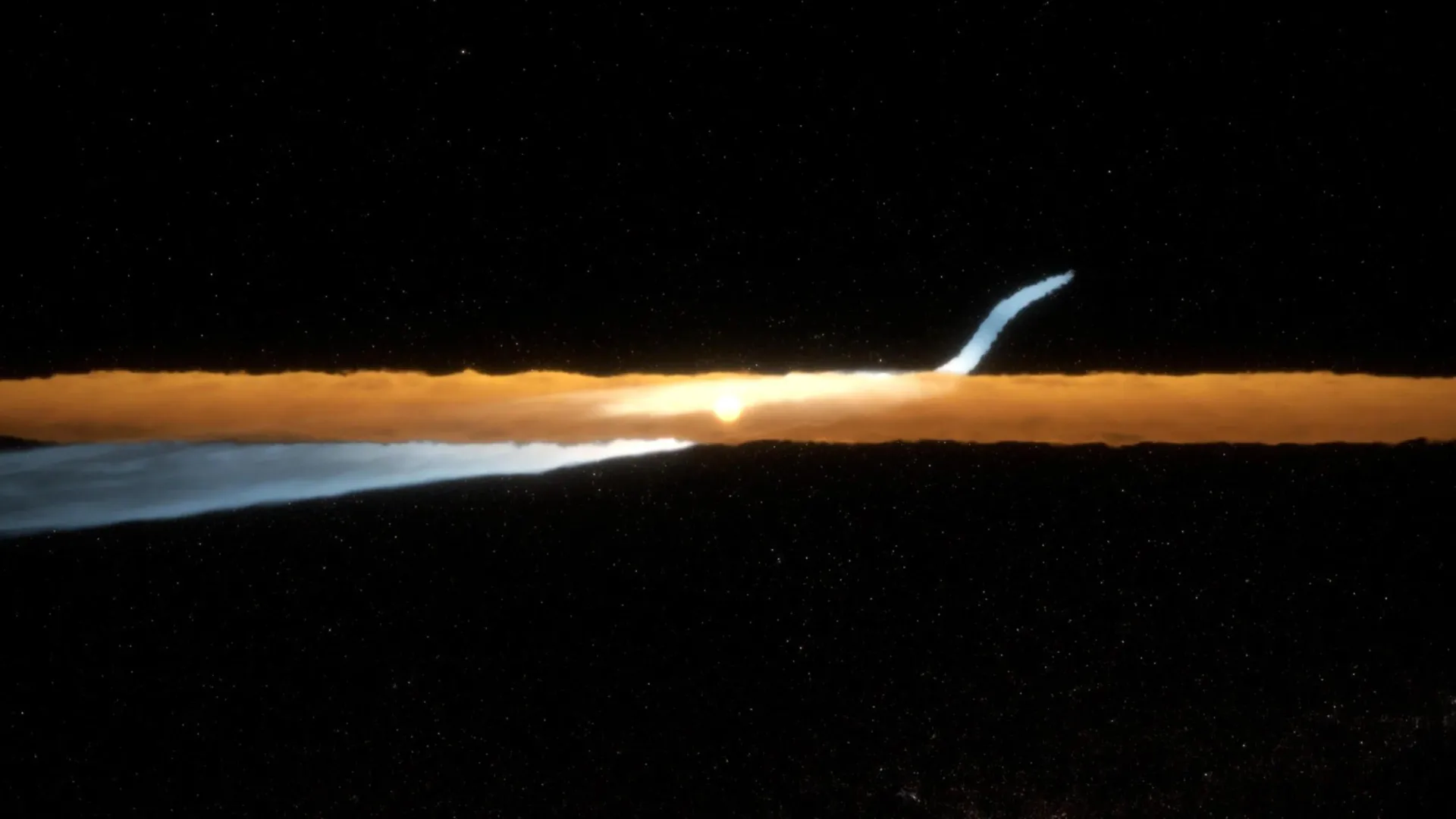
NASA's Hubble Space Telescope has captured new visible-light images of the "Cat's Tail," a mysterious 93-billion-mile structure of dark material orbiting Beta Pictoris, a young star system located 63 light-years away in the constellation Pictor. The discovery appears in The Astrophysical Journal Letters in research led by University of Arizona planetary scientist Arin Avsar.
The Cat's Tail had been detected previously only in infrared light by the James Webb Space Telescope but remained invisible in visible wavelengths until now. Avsar explained the reason: the structure consists almost entirely of organic refractory material, heavily carbon-based compounds that absorb visible light and appear exceptionally dark.
The observations suggest the Cat's Tail formed from a collision between large planetary bodies, possibly Pluto-sized worlds. The debris disk surrounding Beta Pictoris resembles our own solar system during its early development, offering astronomers a window into planetary formation processes that occurred billions of years ago.
The structure contains dust grains measuring only about one micron across, yet remarkably porous rather than compact and solid. Researchers do not fully understand how such small, fluffy particles formed. Co-author Kevin Wagner, a NASA Sagan Postdoctoral Fellow at the University of Arizona's Steward Observatory, proposed that collision velocities may have been high enough to vaporize carbon material into gas, which then recondensed as it cooled, creating porous structures.
Computer modeling combining Hubble's visible-light data with James Webb infrared measurements revealed the Cat's Tail likely extends sideways across the sky rather than projecting deep behind the star, as earlier observations had suggested.
The Hubble observations also identified an unexpected warp in the dust halo surrounding Beta Pictoris, which researchers suspect results from gravitational influence by Beta Pic b, a gas giant approximately 10 times Jupiter's mass.