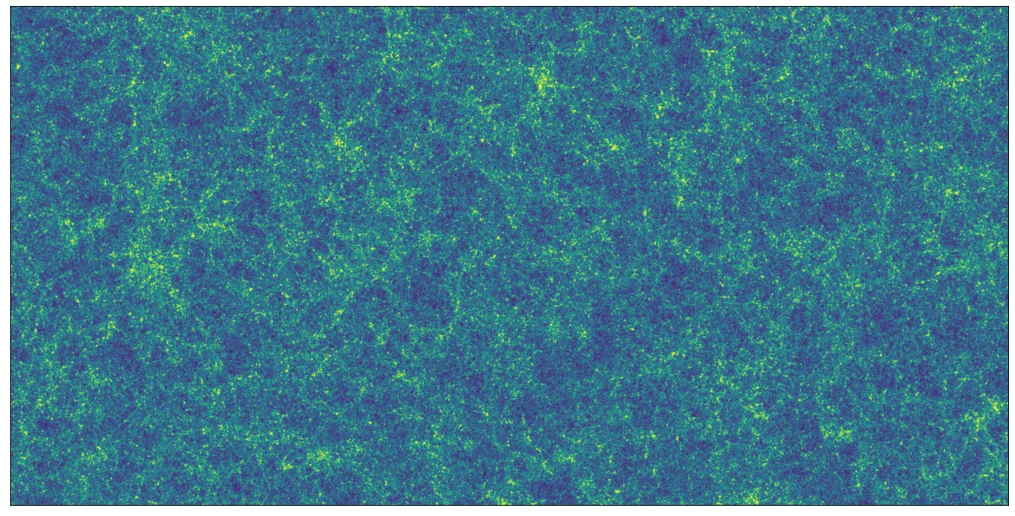
The MeerKLASS Collaboration announced the first direct measurement of cosmic hydrogen's large-scale structure in a study published in the Monthly Notices of the Royal Astronomical Society. Using the MeerKAT radio telescope in South Africa, the international team detected neutral hydrogen signals originating 4.5 billion years ago across approximately 250 square degrees of sky.
The team employed 21-cm intensity mapping, a technique that detects combined emissions from galaxies across large sky segments to build 3D maps of cosmic matter distribution. The hydrogen signal proved difficult to extract, as foreground emissions are about 10,000 times stronger. To overcome this, researchers operated each of the 64 MeerKAT dishes as an independent telescope rather than combining them into a single interferometer, trading angular resolution for survey speed.
The measurements produced independent maps from different dishes and observation times that were cross-compared to suppress instrument effects and reinforce the hydrogen structure. Results showed that cosmic hydrogen mirrors the large-scale structure of the cosmic web.
Dr Steven Cunnington at Purdue University's Institute of Cosmology and Gravitation led development of the analysis pipeline. He noted that the result represents culmination of work begun during his PhD at Portsmouth over a decade ago and is "a remarkable milestone to witness."
Professor Mário Santos, Principal Investigator of the MeerKLASS survey at the University of the Western Cape, called it "a milestone in establishing 21-cm intensity mapping as a novel tool for cosmology." The measurement required a decade of work by researchers across seven countries and three continents.
The data can constrain the Hubble-Lemaître Constant, the influence of Dark Energy, and the distribution of Dark Matter.