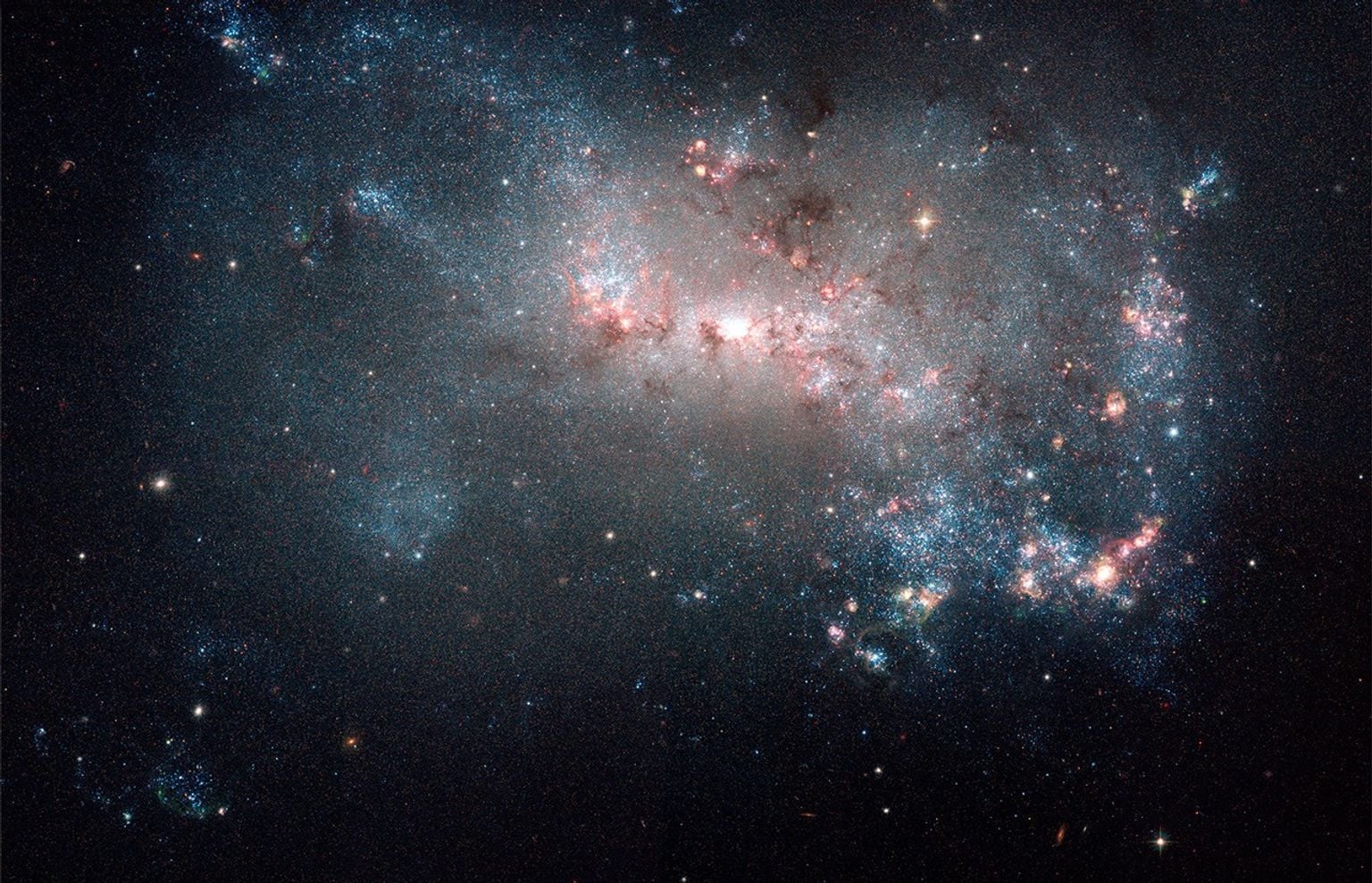
Researchers using the Hubble Space Telescope studied 37 nearby dwarf galaxies and found far less oxygen than expected, according to a paper published in The Astrophysical Journal. The team measured both how much oxygen produced by stars remains in low-mass galaxies and how much has escaped over their lifetimes.
Dwarf galaxies retain only about 15 percent of the oxygen created by their stars, with the rest driven out by radiation from massive stars and supernovae explosions, according to Grace Telford, an assistant professor at the University of Utah's Department of Physics and Astronomy and second author of the paper. The missing oxygen likely resides in the gaseous halos surrounding the galaxies, called the Circumgalactic Medium, and may have traveled even farther into the intergalactic medium.
The research combined data from Hubble, NASA's retired Spitzer Space Telescope, the Very Large Array, and the Australian Telescope Compact Array. Most oxygen in galaxies comes from core-collapse supernovae, the explosive deaths of massive stars. A smaller fraction originates from other types of supernovae involving remnants of low-mass stars.
Low-mass galaxies lose oxygen far more readily than massive galaxies like the Milky Way because they possess weaker gravity. The Milky Way contains roughly one oxygen atom for every 2,000 hydrogen atoms, while low-mass galaxies studied by the GLOW project contain one oxygen atom for every 10,000 to 20,000 hydrogen atoms.
The Galaxies Losing Oxygen via Winds (GLOW) project, jointly funded by NASA and the National Science Foundation, found that dwarf galaxies lose more oxygen than current galaxy formation simulations predict. This suggests incomplete understanding of how massive stars interact with their host galaxies, according to Telford.