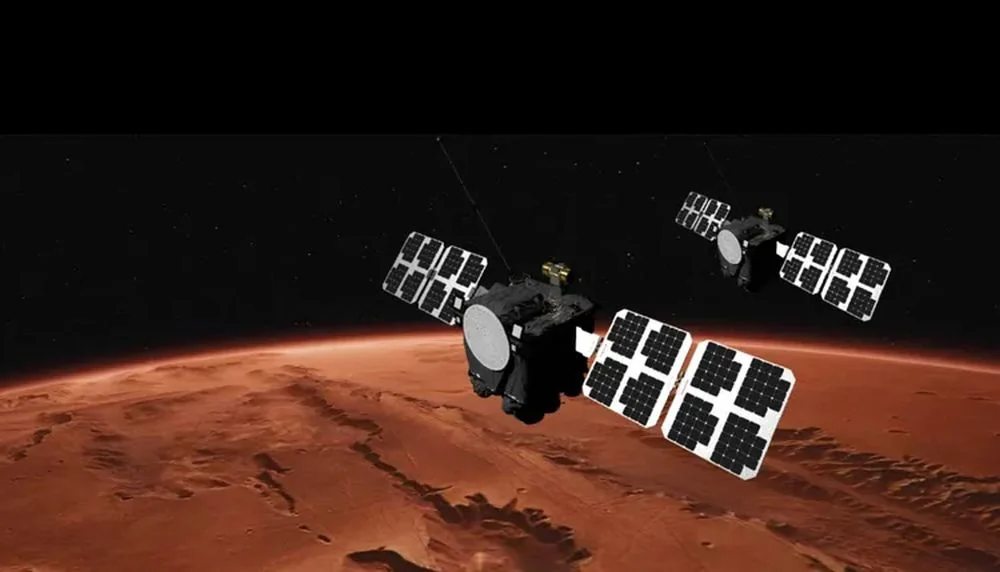
NASA's twin spacecraft ESCAPADE, named Red and Blue, will perform powered slingshot maneuvers above Earth on November 7th and 9th to reach Mars. The spacecraft will execute trans-Mars injection burns lasting about 9 minutes each, boosting their speed from 10.14 km/s to 10.78 km/s. At their closest approach, they'll fly between 965 to 1,770 kilometers above Earth's surface.
ESCAPADE will investigate how Mars lost its ancient atmosphere. The spacecraft will measure how the solar wind interacts with remnants of Mars' crustal magnetic fields, patches of magnetism locked into iron-rich rocks billions of years ago when the planet's molten core cooled and its protective magnetic field vanished. Scientists believe UV radiation from the Sun then drove Mars' thicker ancient atmosphere into space.
The pair will fly in formation around Mars, a first for any spacecraft. Flying together removes uncertainty about whether observed changes result from shifting solar wind interactions or from the spacecraft changing position. NASA calls this configuration the "String of Pearls."
During Science Phase A, lasting about 6 months, both spacecraft will fly the same orbit at varying distances from each other. In Science Phase B, lasting about 5 months, Blue will lower its orbit to about 7,000 km while Red raises its orbit to about 10,000 km. The spacecraft should remain operational for many years beyond the nominal mission end.
Ground observers may see the spacecraft with a telescope as a dim pair of refrigerator-sized objects moving against stars. The spacecraft loitered near the Earth-Sun Lagrange point 2 before approaching Earth, making them the first to observe Earth's magnetotail as bonus science during their transit.