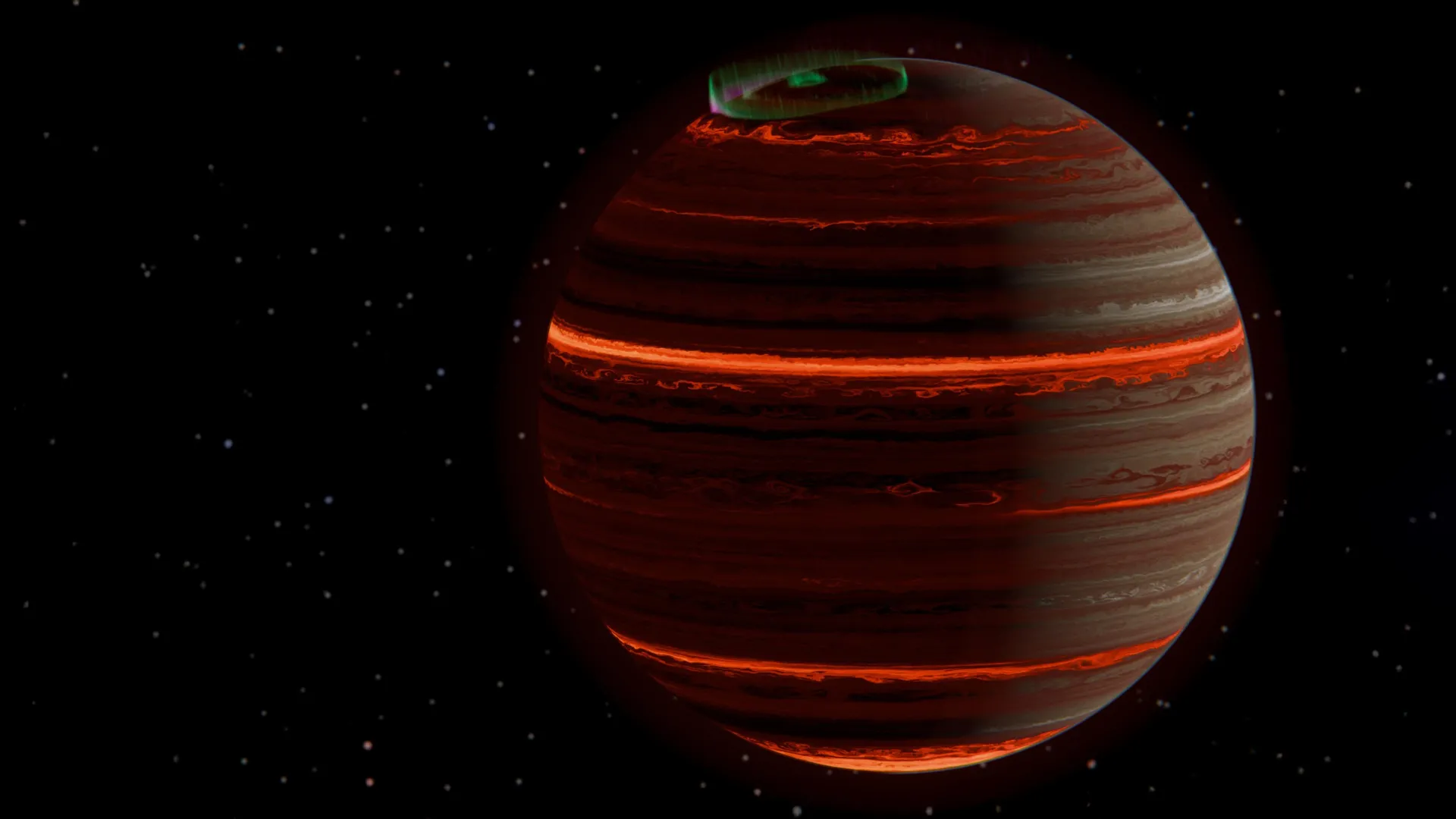
Researchers at Trinity College Dublin used NASA's James Webb Space Telescope to analyze the atmosphere of SIMP 0136, a brown dwarf located 20 light-years from Earth. They applied a mathematical technique called Principal Component Analysis to observations of the object as it rotated, revealing patterns in how its brightness changed at different wavelengths.
The team discovered that SIMP 0136's complex atmosphere is governed primarily by two factors: temperature changes and the vertical structure of its clouds. The brown dwarf displays three recurring weather states that create a shifting atmospheric patchwork as it rotates, with some regions hotter and thinner-clouded while others are cooler with thicker, more vertically extended cloud layers. Despite appearing chaotic, these patterns persist over more than a dozen rotations of the object.
"We also discovered that these drivers of the weather patterns on SIMP-0136 persist over time, even as the detailed appearance of the atmosphere evolves over more than a dozen rotations," said Merle Schrader, first author and PhD candidate at Trinity's School of Physics.
The findings, published in Astronomy & Astrophysics, demonstrate that Webb's sensitive instruments can detect minute brightness variations in an object appearing as a single point in observations, extracting detailed atmospheric information from faint light signals.
The technique could accelerate investigations of giant exoplanets. Because brown dwarfs can be observed directly while most exoplanets cannot, they offer a valuable testing ground for understanding how clouds form and heat moves through atmospheres under extreme conditions. Professor Johanna Vos noted that this approach "offers an efficient first step before we begin computationally intensive modeling" of JWST observations of brown dwarfs and giant exoplanets.