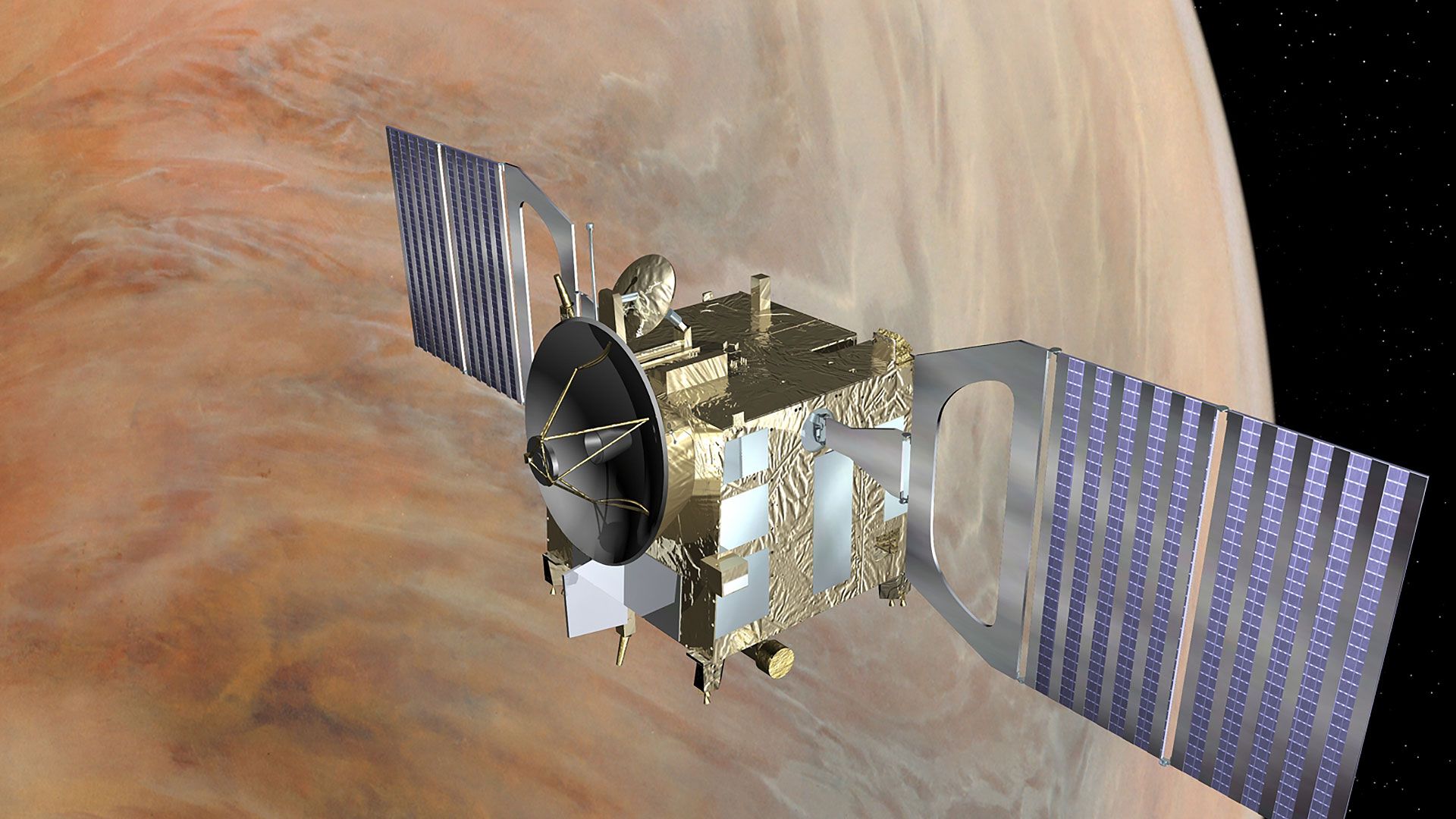
On November 8, 2005, the European Space Agency launched Venus Express aboard a Russian Soyuz rocket, making it Europe's first mission to Venus.
Venus Express orbited the planet for more than nine years despite the harsh environment. The spacecraft endured extreme atmospheric pressure, radiation, and temperatures that could crush an unprotected probe. During its mission, Venus Express detected a vortex swirling around Venus's south pole, identified possible signs of active volcanoes, and discovered that Venus generates its own auroras, which occur when solar particles collide with charged particles in the planet's atmosphere.
Late in the mission, ESA controllers directed the spacecraft to descend into Venus's clouds, a maneuver beyond its original design. The spacecraft performed the dive but eventually stopped responding to commands. It burned up in the atmosphere in January 2015.
Venus Express established the ESA as the third world organization to successfully send a probe to Venus, after the United States and Soviet Union. Japan's JAXA became the fourth five years later. The mission's data suggested Venus may have hosted habitable oceans before becoming inhospitable, offering insights into how Earth-like planets evolve over time.