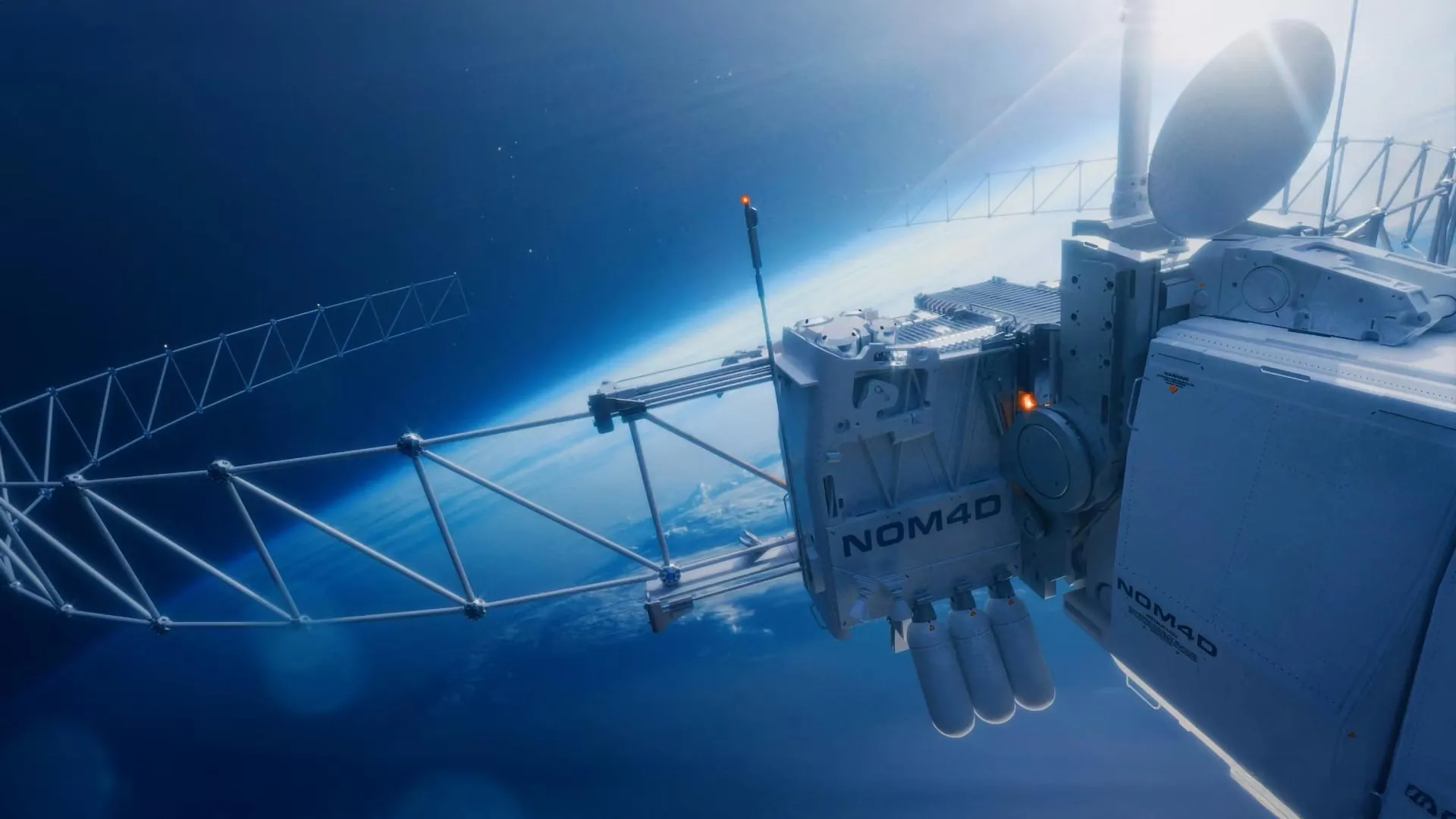
A robot developed by Caltech with funding from DARPA successfully assembled part of a structure in space for the first time, operating without astronaut assistance. The robotic system, part of DARPA's NOM4D program, used an automated arm to retrieve structural tubes and connecting joints from storage dispensers, joining them into repeating sections called bays that form a truss framework.
The robot spent six months in orbit attempting to construct a reflector antenna measuring 1.4 meters across. Its design combined composite fiber tubes, aluminum connectors, and a lightweight reflective surface made from Kapton polymer film. Technical difficulties and scheduling constraints prevented completion of the entire antenna, but the robot successfully assembled an initial section, proving the construction method can work in orbit.
Sergio Pellegrino, the Joyce and Krent Kresa Professor of Aerospace and Civil Engineering at Caltech and executive officer for aerospace, leads the Autonomous In-Space Tensioned Reflector Assembly (ASTRA) demonstration. "This is the first time that a structure has been autonomously constructed in space," Pellegrino states.
ASTRA launched on March 30, 2026, aboard a SpaceX Transporter-16 mission from Vandenberg Space Force Base. The payload traveled on Momentus Inc.'s Vigoride 7 orbital vehicle in a compact package occupying approximately one cubic meter of space. After reaching orbit, researchers transmitted instructions to the onboard computer through the Vigoride spacecraft. Three team members managed construction commands from Earth: Charles Sommer, a former Caltech systems engineer; Alan Truong, a Caltech research engineer; and graduate student Tara Venkatadri.
Robotic assembly in orbit could eventually enable construction of structures hundreds of meters or kilometers in scale. Current spacecraft designs face constraints from rocket fairing dimensions, limiting the size of structures that can launch. DARPA's NOM4D program, established in 2022, investigates technologies for in-orbit manufacturing. Caltech's ASTRA and a University of Illinois Urbana-Champaign project were the only two selected to advance to the program's third phase for demonstrating construction in orbit.