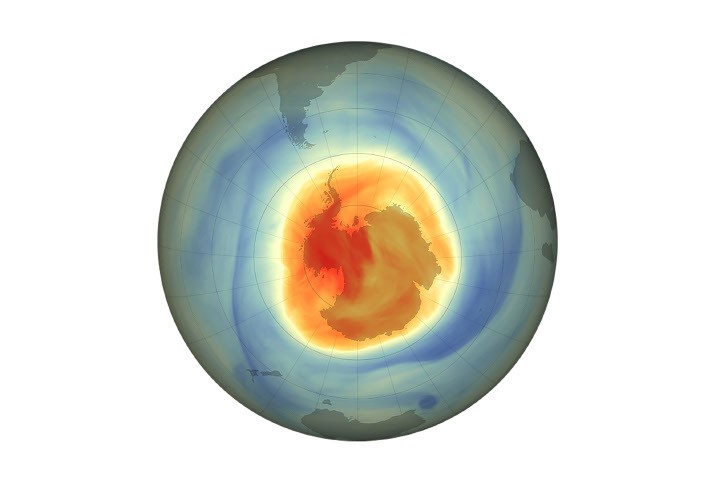
The Antarctic ozone hole reached its 2026 maximum on September 18, when ozone concentrations dropped below 220 Dobson units across a large area over the continent. Measured by mean size from September 7 to October 13, the 2026 hole was the seventh largest in 48 years of monitoring.
An unusually strong Antarctic polar vortex created ideal conditions for ozone depletion over a large area. Year-to-year fluctuations result from variations in stratospheric temperature and circulation. Colder conditions produce larger holes with lower ozone values in the core.
NASA satellites and ground-based instruments have tracked the ozone hole since 1979. The deepest hole on record occurred in 1994, when ozone concentrations fell to 73 Dobson units on September 30. The largest hole occurred in 2006. Records in depth and area have never occurred in the same year.
Scientists attribute ozone depletion to chlorofluorocarbons, or CFCs, long-lived chemicals used in refrigerators and aerosol sprays since the 1930s. When CFCs reach the stratosphere, ultraviolet light breaks them apart and releases chlorine, which catalyzes ozone destruction. The 1987 Montreal Protocol phased out production and consumption of ozone-depleting chemicals. Scientists estimate about 80 percent of stratospheric chlorine today comes from human sources.
In 2018, scientists reported the first direct satellite evidence of ozone recovery, observing a 20 percent decrease in ozone depletion from 2005 to 2016. Models suggest stratospheric chlorine and other ozone-depleting substances will not return to pre-1980 levels until later in the 21st century. Scientists estimate the Antarctic ozone layer will return to 1980 levels in the 2070s.