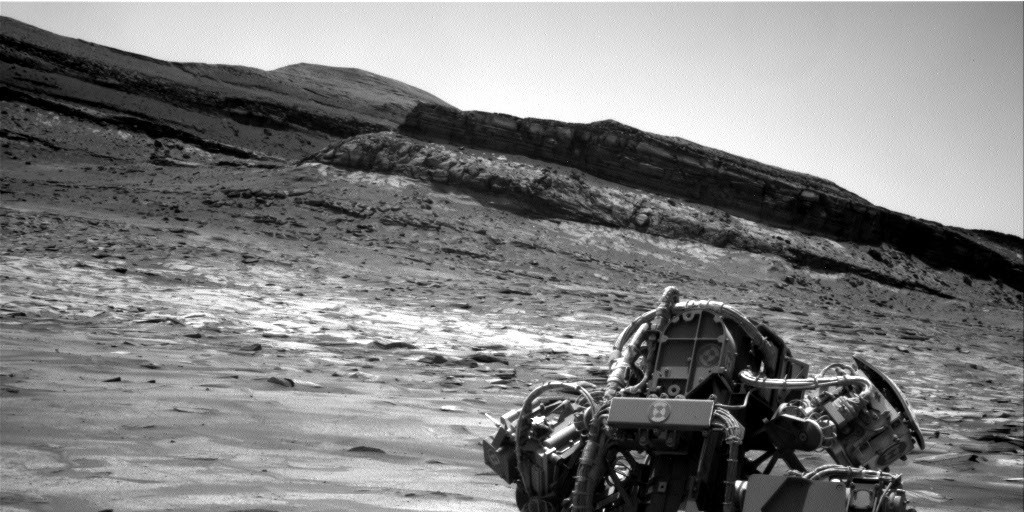
NASA's Curiosity rover entered a low-activity recharge period on sols 5060 through 5062 to build up power reserves before resuming its drilling campaign at a rock target called Nazca.
The rover has already drilled the hole and analyzed tailings from the site using its ChemCam and Remote Micro-Imager instruments. More work remains, including additional sample dropoffs to the SAM and CheMin instruments, a cleanup procedure called RAGE (Rotate to Agitate for Granule Expulsion), and imaging documentation. These activities consume substantial power, so the operations team scheduled three sols with minimal demands.
During the recharge period, Curiosity still conducted remote science. The rover used ChemCam and its Mastcam to image targets named Titicaca, Pampas, and Salta, observed dust devils with its Navigation Camera, and captured twilight images. Engineers also tested a power-saving strategy on sol 5061. The test paired two activities that normally run separately: transferring data from the CheMin instrument to flight computers while simultaneously sending data to an orbiter. Running both activities at once reduces the time the rover remains powered up, conserving energy as Curiosity ages and its power output gradually decreases. Remington Free, an Operations Systems Engineer at NASA-JPL, wrote that the test "seems to have gone well," pending analysis by the engineering team.