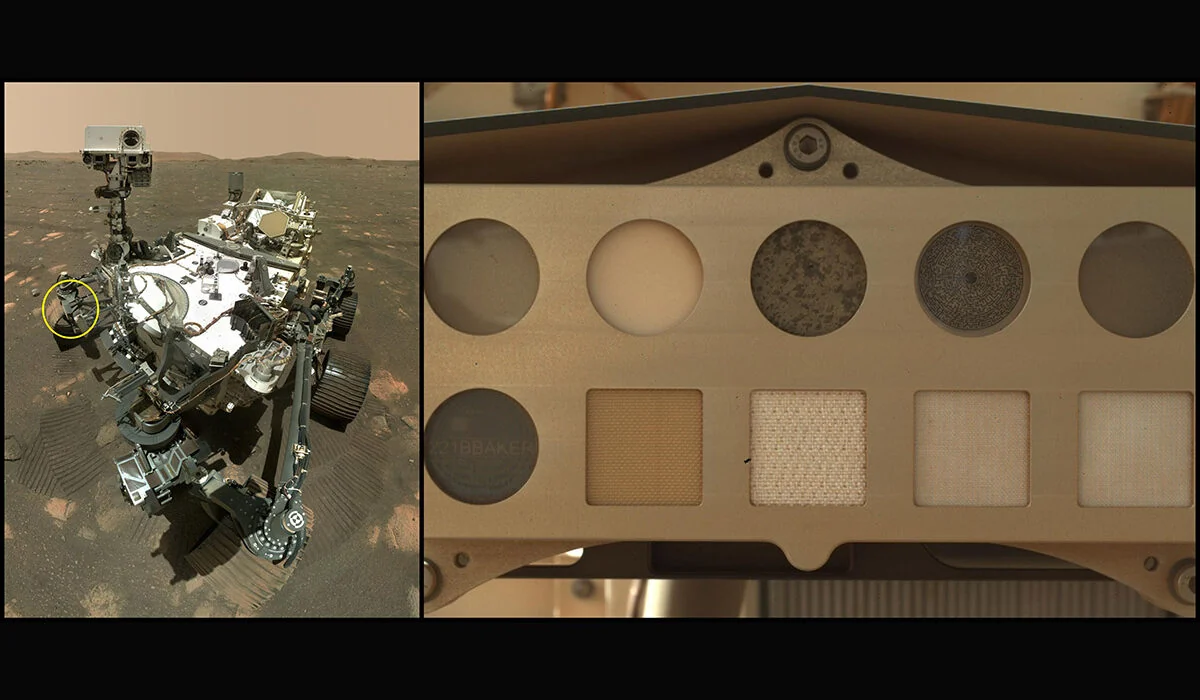
NASA's Perseverance rover is testing how Martian dust affects spacesuit materials, data that could inform how astronauts prepare for human missions to Mars.
A team led by Washington University in St. Louis, including scientists from MIT Haystack Observatory, the Commonwealth Scientific and Industrial Research Organisation, and NASA's Jet Propulsion Laboratory, examined small swatches of spacesuit material carried by Perseverance. Using the rover's Planetary Instrument for X-ray Lithochemistry (PIXL), they analyzed the swatches after 1,645 Martian days of exposure.
The swatches showed little visible wear. The particles observed were much smoother than the jagged grains found on the Moon, suggesting Martian dust may be less abrasive to equipment and less irritating to lungs than lunar regolith.
However, the dust poses other hazards. The analysis confirmed the presence of perchlorates and toxins, along with high levels of sulfur, iron, and silica. Some ultrafine particles measured as little as 100 nanometers in diameter. On Earth, ultrafine particles can sink deep into lungs and enter the bloodstream, and carrying perchlorates magnifies this risk.
Martian dust is also electrostatically charged, causing it to preferentially adhere to surfaces. "The electrostatic properties of Martian dust are likely causing it to preferentially adhere to some surfaces," said staff scientist Abigail Knight.
Mission planners must account for these factors when designing spacesuits and habitats. Dust tracked into enclosed spaces could accumulate and pose a health threat. The health risk depends on dose and duration, and proper mitigation strategies can limit both to acceptable levels.