NASA's Science Mission Directorate faces budget requests proposing cuts of nearly 50% in fiscal years 2026 and 2027, with more than 50 science missions facing termination or delay. In response, the agency is shifting toward cheaper, internally directed missions while competitive programs that have produced celebrated discoveries now face extended gaps.
The agency has launched the Commercial Lunar Payload Services (CLPS) program, which buys rides for NASA instruments on commercial lunar landers, and selected internally directed missions including SkyFall helicopters and Aeolus instruments for Mars, plus the PROMISE rover for the Moon. Meanwhile, Discovery-class missions face a seven-year gap between Psyche's 2023 launch and DAVINCI's expected 2030 launch. The New Frontiers program, which selected Dragonfly in 2019, will see at least a full 10-year gap before its next mission selection.
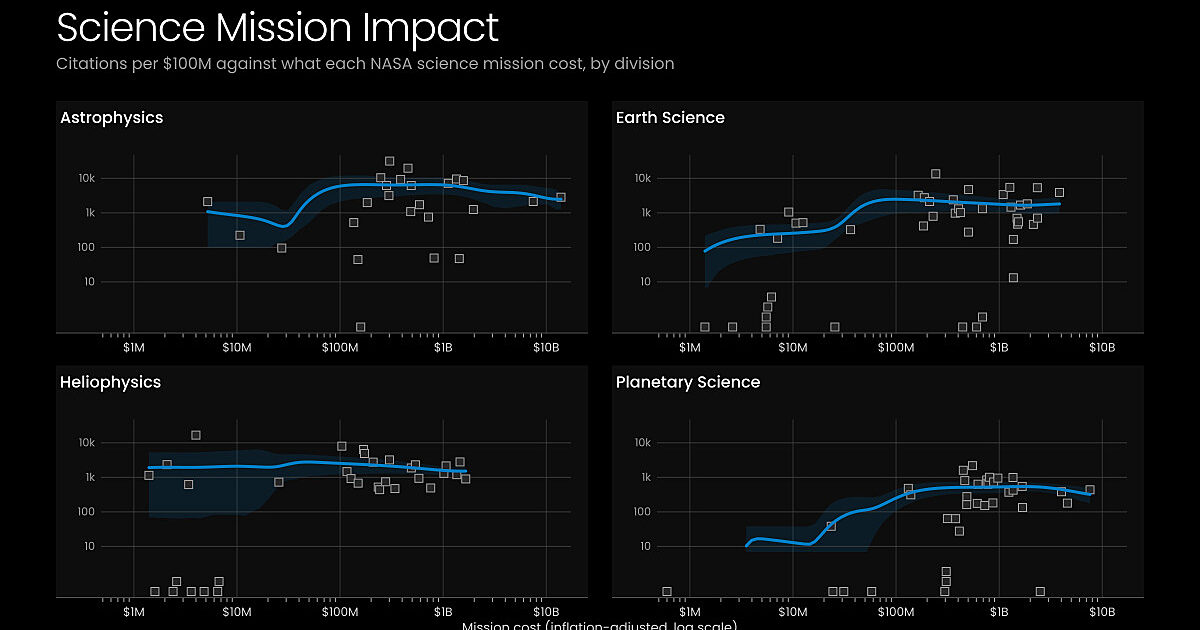
The Planetary Society assembled a database tracking 143 NASA-led scientific spacecraft launched from 1980 through 2024 across all five science divisions, with life-cycle costs adjusted to 2025 dollars and peer-reviewed publication counts from NASA's SciX Digital Library.
The analysis found that mid-cost missions between $150 million and $1 billion, such as Discovery, Explorer, and New Frontiers classes, matched or beat both cheaper and more expensive missions in science output per dollar in three of four comparable science divisions. Cheaper missions failed far more often. Of missions below $150 million, 30% failed, compared to 8% failure among more expensive missions. For smaller missions to match larger ones in efficiency, each surviving small mission would need to be about a third more productive on average, but they are not.
Competed missions also returned excellent scientific impact per dollar. Among mid-cost missions, the most productive have been led by independent scientists who proposed them in open NASA competitions rather than directed internally. The four CLPS missions flown so far produced fewer papers than comparable NASA-led science missions.