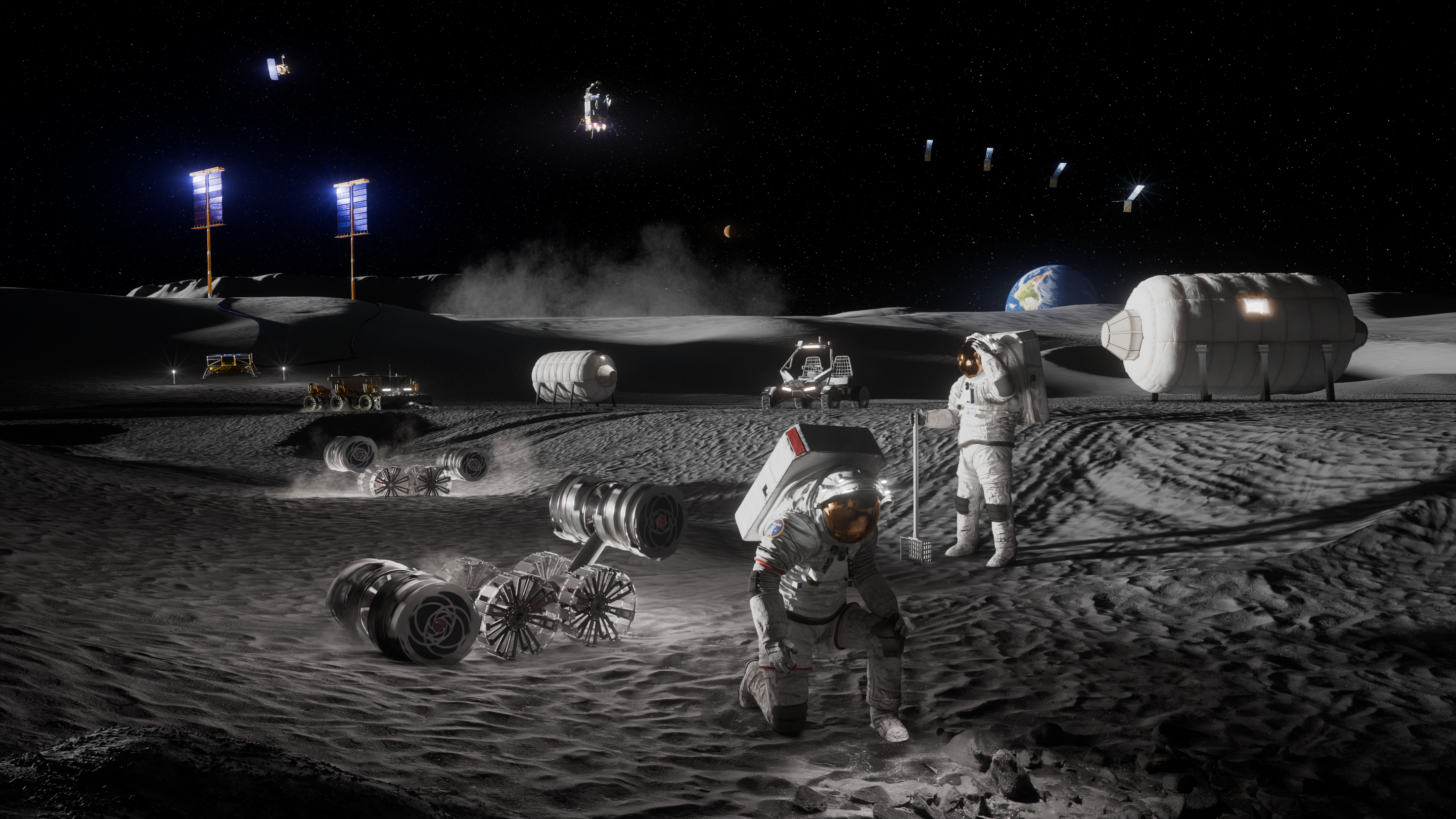
NASA has selected three new scientific investigations to support construction and operations of Moon Base, the agency's planned lunar outpost. These investigations represent a strategic expansion of the robotic science missions that will precede human arrival and establish the knowledge foundation for sustainable lunar habitation.
The selected investigations will deploy instrument packages designed to characterize the lunar environment in ways that directly benefit Moon Base operations. This approach differs from pure exploration missions. These payloads serve dual purposes: advancing fundamental lunar science while gathering operational data essential for human crews. NASA's strategy relies on iterative robotic missions to identify water ice deposits, assess radiation exposure, evaluate regolith composition, and map terrain hazards before astronauts arrive.
Moon Base represents NASA's commitment to sustained lunar presence beyond brief Apollo-era visits. The outpost will serve as a testbed for technologies needed for Mars exploration and as a platform for long-duration scientific research. Unlike temporary camps, a permanent base demands detailed environmental characterization. Robots must map subsurface geology, measure thermal conditions in permanently shadowed regions, and monitor dust behavior that could damage equipment and spacesuits.
The three investigations join existing payloads already slated for lunar delivery through Commercial Lunar Payload Services (CLPS) missions and NASA's Artemis campaign. CLPS contracts leverage private companies including Intuitive Machines, Astrobotic, and Firefly Aerospace to deliver science packages at lower cost than traditional government-developed systems. This commercial approach accelerates the science timeline and reduces development risk.
One of the selected investigations focuses on subsurface properties critical for habitat placement and resource extraction. Another examines the lunar radiation environment at potential Moon Base sites. A third investigation, the DISCO payload, advances technology demonstrations for future missions. Each investigation required peer review and evaluation for scientific merit, technical feasibility, and alignment with Artemis objectives.
Water ice discovery in lunar polar regions transformed lunar exploration strategy. NASA's Lunar Reconnaissance Orbiter and India's Chandrayaan missions detected ice signatures in permanently shadowed craters near both poles. Moon Base likely will occupy the lunar south polar region to maximize access to these ice deposits. Water provides drinking water, oxygen production, and rocket propellant. Confirming ice abundance and accessibility determines Moon Base's long-term sustainability.
The selected investigations will operate on multiple platforms. Some will deploy from landers in CLPS missions. Others may reach the surface aboard Artemis-era payloads. A few could eventually integrate with human-tended experiments once crews establish the base. This phased approach spreads costs across multiple fiscal years while building operational experience with lunar hardware.
NASA's Artemis program targets return of humans to the Moon by 2025 or 2026, with Moon Base deployment following within the subsequent decade. These new investigations directly support that timeline by collecting data needed for site selection, habitat design, and resource management protocols. The payloads represent a deliberate escalation from exploration toward utilization.
By combining robotic science with human spaceflight objectives, NASA accelerates progress toward sustained lunar presence while advancing planetary science. The selected investigations demonstrate how exploration and operational requirements converge on the Moon, where science enables infrastructure and infrastructure enables discovery.