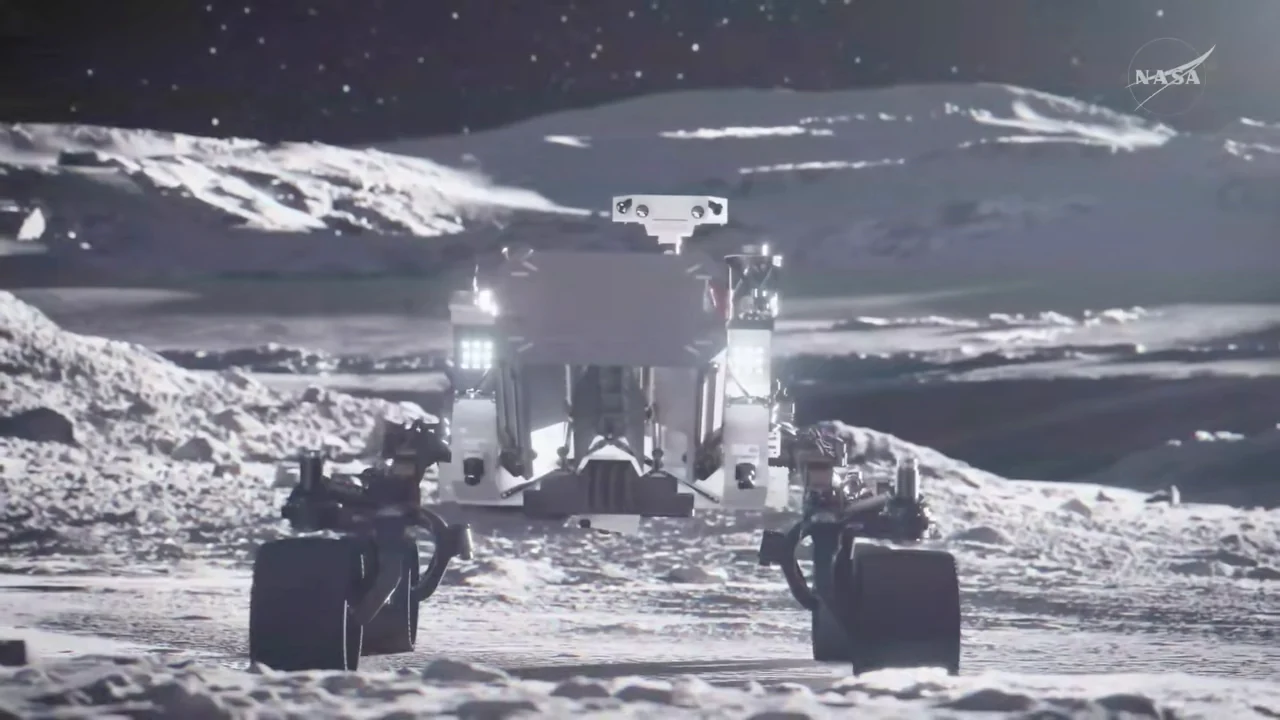
NASA booked PROMISE, a nuclear-powered rover, on a ride to the lunar south pole aboard Blue Origin's Blue Moon Mark 1 lander. The mission targets late 2028 with an 18-month prime mission. PROMISE, the Polar Rover for Observation, Mapping, and In-Situ Exploration, builds on hardware from NASA's Mars rovers Curiosity and Perseverance. A flight-spare radioisotope thermoelectric generator will power the rover and allow it to survive lunar darkness and explore permanently shadowed regions.
The rover carries instruments including copies of VIPER's TRIDENT drill, which can sample down to one meter, plus multiple spectrometers, an infrared radiometer, and a laser retroreflector. Computing tests will demonstrate onboard terrain mapping and navigation in darkness.
NASA estimates PROMISE will cost below $400 million, including surface delivery. The agency awarded Blue Origin $94 million as a base contract, with a further $140 million performance-based option.
Alongside PROMISE, NASA selected components for miniCAST, the Mini-Communications and Solar Tower. Honeybee Robotics will provide energy storage, Redwire will supply power generation, and Yank Technologies will deliver wireless power transfer. Marshall Space Flight Center will integrate and test the industry-supplied components. Ise described rovers using tower communications to navigate toward a power source and recharge through an induction plate on the surface.
NASA also announced six Venture-Class Acquisition of Dedicated and Rideshare (VADR) task orders totaling approximately $1.3 billion for lunar transportation. Eight providers qualified for Commercial Lunar Payload Services (CLPS) 2.0 deliveries: Blue Origin, Firefly Aerospace, Intuitive Machines, ispace U.S., Lockheed Martin, Northrop Grumman, SpaceX, and Voyager Technologies.
NASA Administrator Jared Isaacman said the agency is "putting our engineers and technicians alongside theirs, whether they like it or not" to prepare industry hardware for flight.