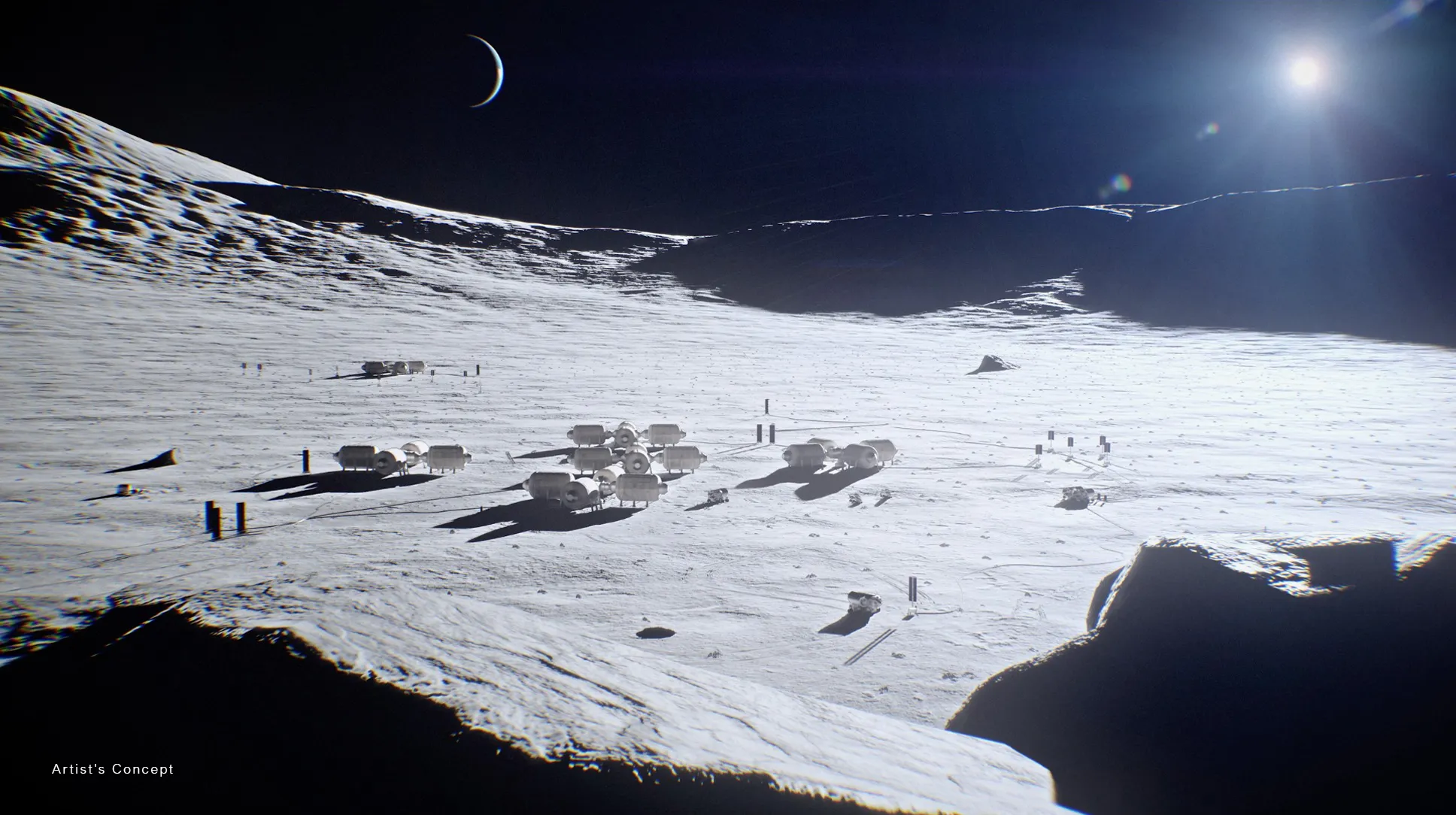
NASA announced awards and contracts to expand Moon Base capabilities, selecting eight companies for cargo lander services and advancing development of a nuclear-powered rover and orbital transfer systems.
Eight companies qualified for the next phase of the Commercial Lunar Payload Services (CLPS 2) initiative: Blue Origin, Firefly Aerospace, Intuitive Machines, iSpace US, Lockheed Martin Space, Northrop Grumman Space Systems, SpaceX, and Voyager Technologies. Under the 10-year CLPS 2 master contract, these companies will build and operate landers to deliver NASA payloads to the Moon. The contract has a combined maximum value of $10 billion. NASA also increased funding for the current CLPS 1.0 contract from $2.6 billion to $4.2 billion, extending operations through November 2033.
NASA is moving forward with PROMISE (Polar Rover for Observation, Mapping, and In-Situ Exploration), a six-wheeled nuclear-powered rover that will operate at the Moon's South Pole during long lunar nights and in permanently shadowed regions. The rover will carry a drill to extract lunar dust from approximately 3 feet below the surface, spectrometers, temperature and radiation sensors, and visible-light cameras. NASA's Jet Propulsion Laboratory will manage the mission and build the rover using spare components and test models from NASA's Curiosity and Perseverance Mars rovers. Blue Origin received a $94 million base contract with an option worth an additional $140 million to deliver PROMISE using its Mark 1 lander. NASA targets late 2028 for launch and plans an 18-month mission.
NASA awarded six task orders under its Venture-Class Acquisition of Dedicated and Rideshare (VADR) launch services contract to Arrow Science and Technology, Blue Origin, and Impulse Space. The combined value is approximately $1.3 billion. These missions will test communication and navigation systems, deploy mobile drones to survey the lunar South Pole, and demonstrate orbital transfer vehicle capabilities. Some missions will launch aboard Blue Origin's New Glenn, Relativity Space's Terran R, and SpaceX's Falcon 9.
NASA Administrator Jared Isaacman said, "When our astronauts return to the Moon, they will arrive with the first elements of the Moon Base already waiting for them on the surface."