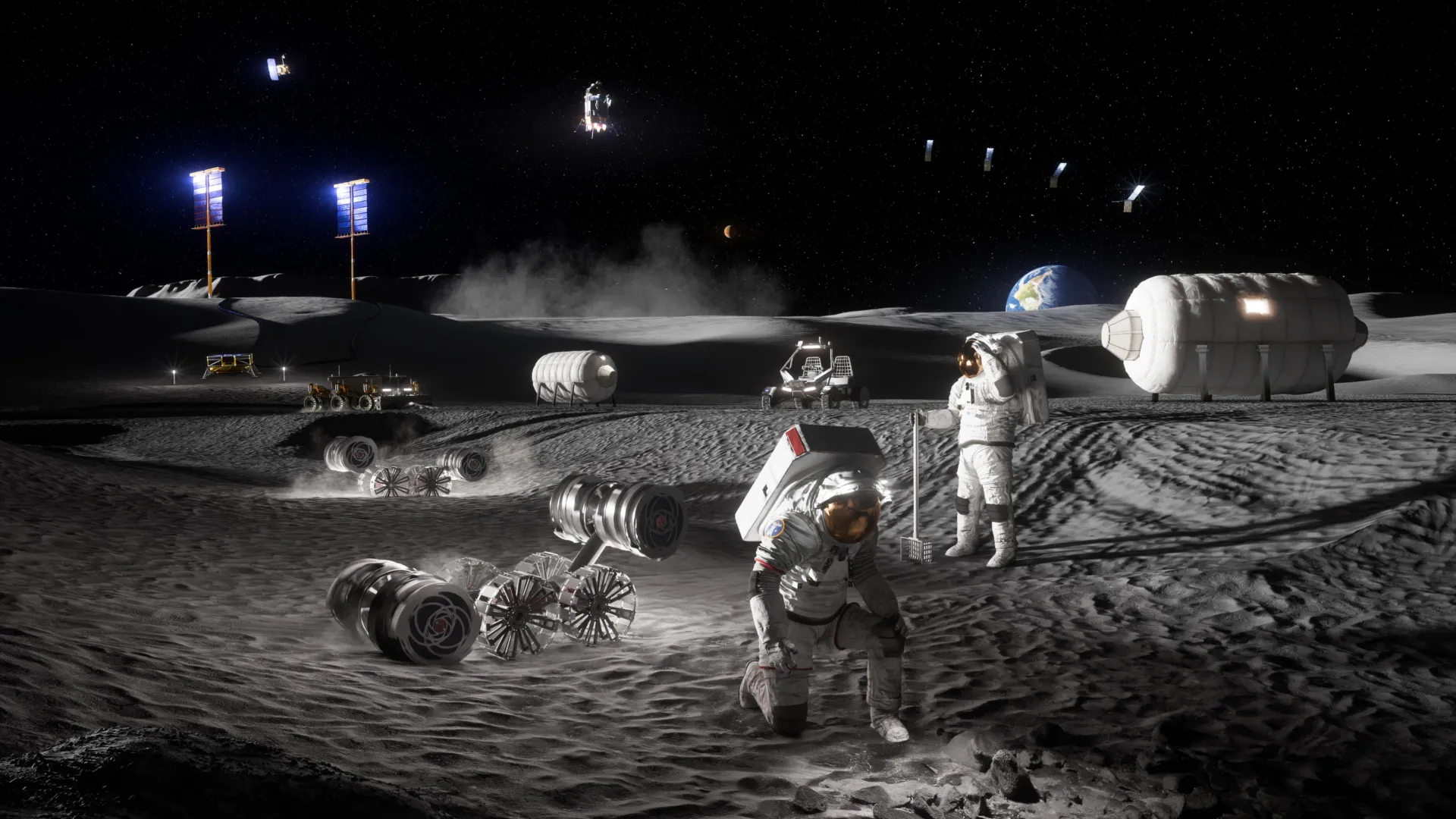
NASA selected three scientific investigations to prepare for humanity's first Moon base. The missions will search for underground caves, map lunar ice deposits, and monitor environmental hazards threatening future explorers.
The Lunar Environment Monitoring Station - South Pole (LEMS-SP), led by Dr. Mehdi Benna of the University of Maryland, Baltimore County, will track micrometeoroids, volatiles, and seismic activity. Unlike Earth, the Moon lacks atmosphere to burn up incoming space debris, making impacts a concern for equipment and habitats. A short-period seismometer will detect moonquakes and vibrations to help engineers design safer infrastructure.
The Geophysical Instruments for Marius Lunar pit Investigation (GIMLI), led by Dr. Nathaniel Putzig of the Planetary Science Institute, will examine the Marius Hills Pit. Scientists believe it may connect to an extensive underground lava tube. These hollow tunnels, formed when lava drained from cooled outer surfaces, could shelter astronauts from intense temperature swings, harmful radiation, and micrometeorite impacts. GIMLI will use geophysical measurements to determine whether large underground spaces exist and how they could influence habitat placement and design.
The Depth Imager with Spectral and Color Optics (DISCO), led by Dr. Ariel Deutsch of NASA's Ames Research Center, will make the first direct measurements of ice in micro-cold traps on the lunar surface. Water ice could provide astronauts with locally sourced water and potentially oxygen and hydrogen. DISCO will also examine how rocket exhaust affects the surface and terrain stability for safer landing and operations.
The three investigations will be delivered through NASA's Commercial Lunar Payload Services (CLPS) initiative as part of its Moon Base Program and will support the Artemis program.