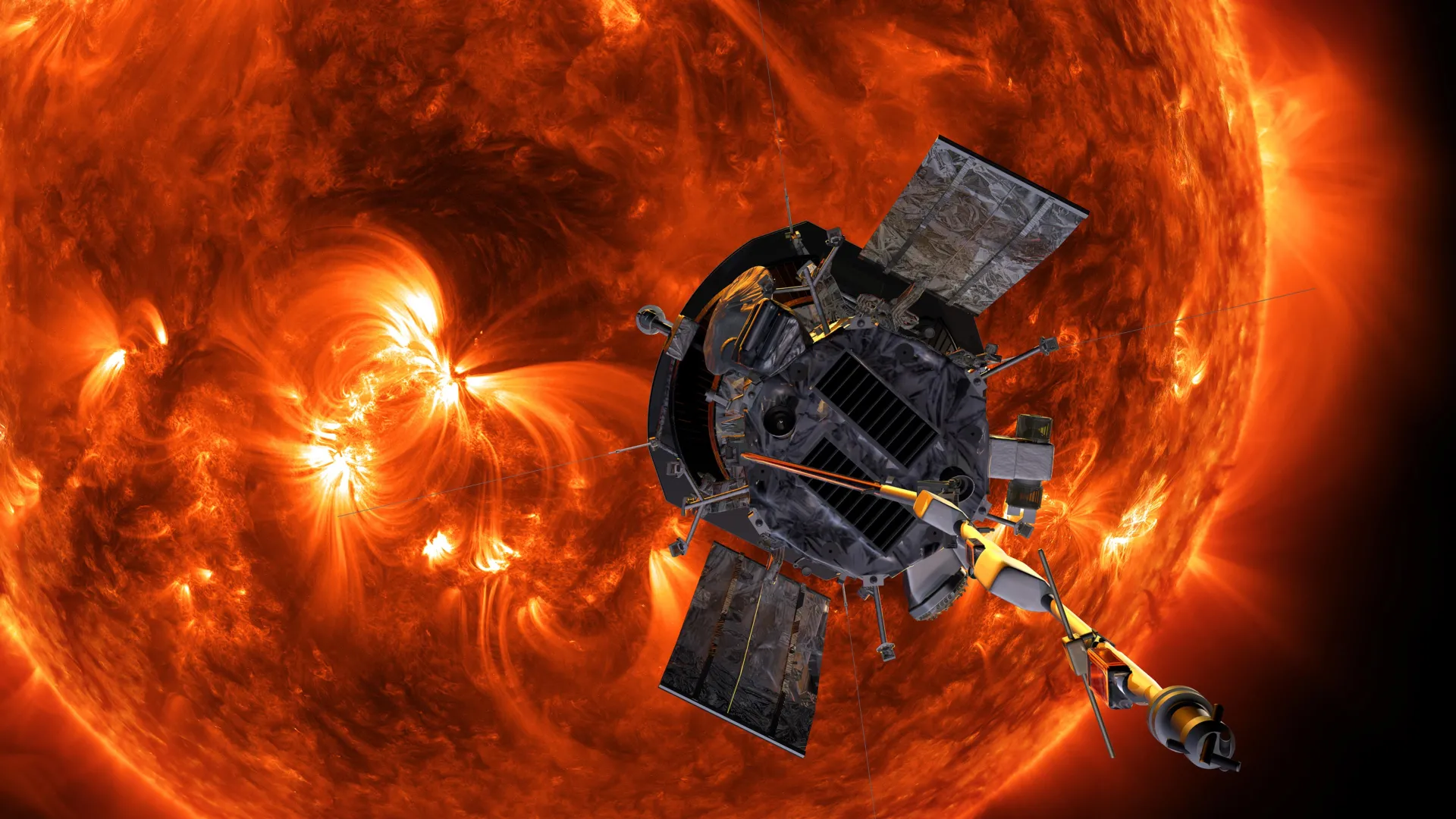
NASA's Parker Solar Probe has detected a hidden magnetic pattern in the Sun's turbulent plasma, revealing that magnetic fields reverse their direction of rotation at specific wavelengths.
Researchers from Technische Universität Braunschweig, the University of Tokyo, Tohoku University, Kyushu University, Osaka University, and other international institutions analyzed precise measurements of magnetic fields and particles collected by Parker Solar Probe. They found that at larger scales, magnetic fields rotate counterclockwise when viewed along a direction pointing outward from the Sun. At much smaller scales, the rotation switches to clockwise.
The reversal occurs at the boundary where plasma transitions from behaving like a fluid to exhibiting dynamics governed by individual particles. As the solar wind travels farther from the Sun, the reversal becomes more pronounced and shifts toward longer wavelengths.
"We see a clear structure in the spectrum, even though the turbulence represents unstructured motions," said Dr. Masatomi Iizawa of TU Braunschweig, the study's first author. The findings appear in The Astrophysical Journal Letters.
Understanding this magnetic pattern could improve models used to predict geomagnetic storms. Plasma turbulence affects Earth's magnetosphere, the solar wind, regions following solar eruptions, and shock waves traveling through interplanetary space after eruptions on the Sun. These disturbances play an important role in geomagnetic storms.