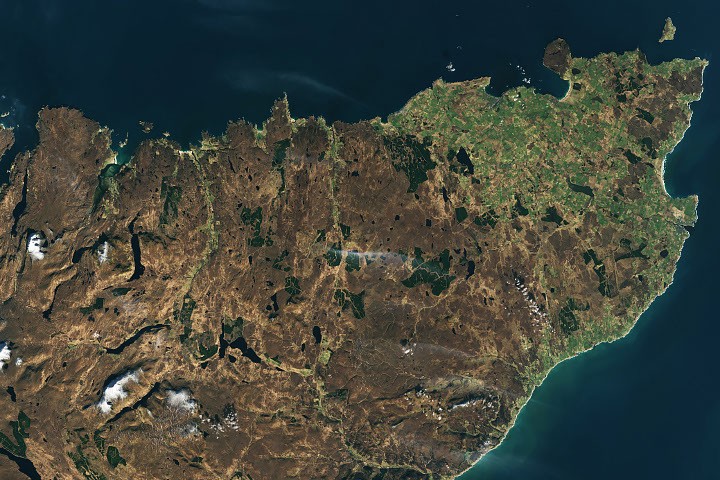
The blanket bogs of Scotland's Flow Country store vast quantities of carbon in waterlogged soils where dead plant material accumulates rather than decomposing. The Landsat 8 satellite captured an image of this peatland ecosystem in the Scottish Highlands, which covers roughly 1,900 square kilometers across the region.
The bogs appear dark brown in the satellite image and contain more than 30 species of sphagnum moss. Some areas have accumulated peat for more than 9,000 years, building deposits exceeding eight meters thick. The Flow Country became the first blanket bog ecosystem to receive UNESCO World Heritage Site status.
Blanket bogs globally cover just 120,000 square kilometers, less than one-tenth of one percent of Earth's land surface. They form only in places with abundant rainfall, poor drainage, and low evapotranspiration. The waterlogged conditions prevent microbes from fully breaking down dead plant matter, allowing the carbon-rich material called peat to accumulate.
Peatlands occupy only 3 percent of Earth's land surface but store more than 600 gigatons of carbon, about twice as much as all the world's forests combined. Forests release their stored carbon when trees burn or die, while peat bogs often preserve carbon for thousands of years.