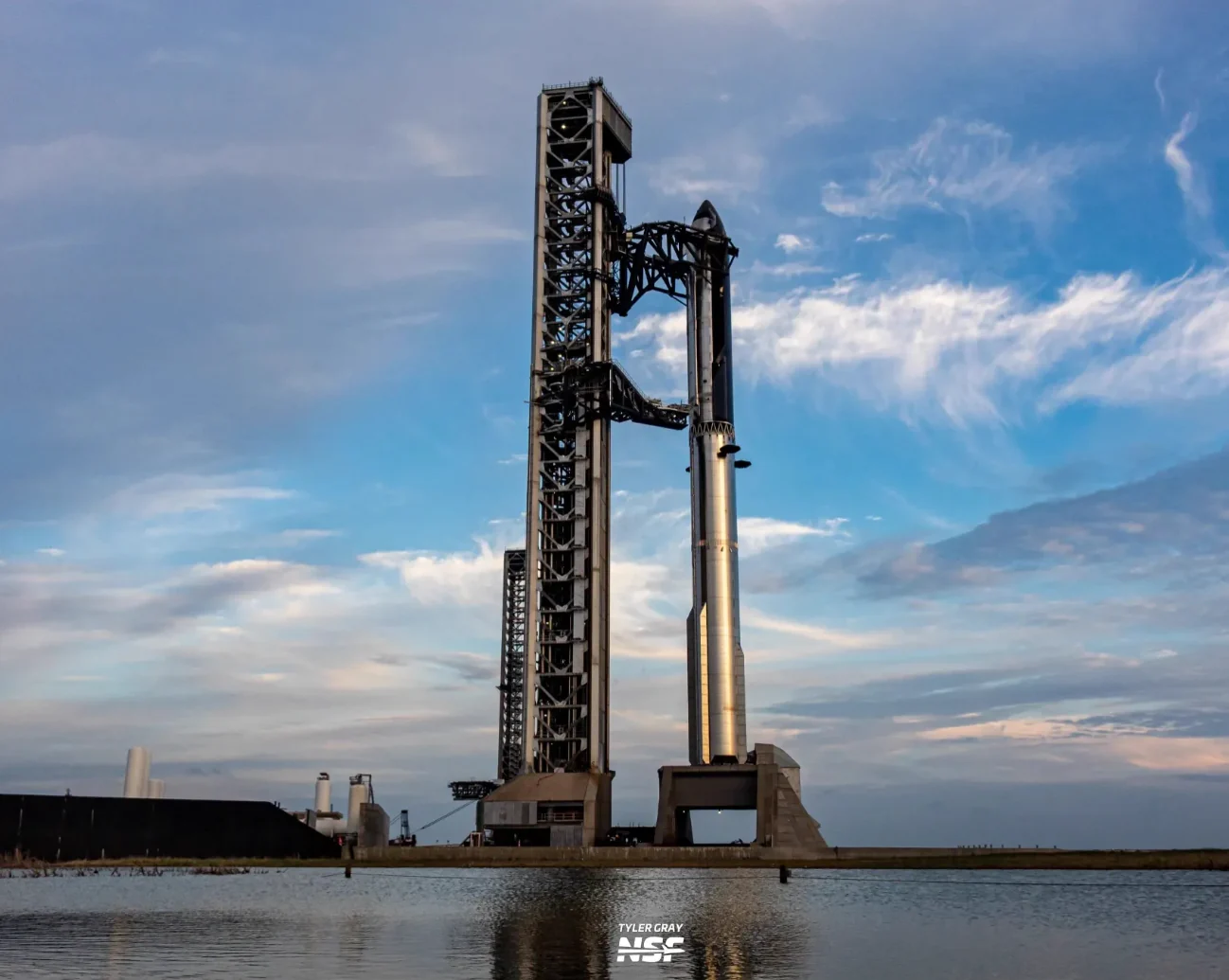
SpaceX will attempt to catch both stages of Starship on Flight 15, a mission that would be the first time in spaceflight history that an orbital-class rocket brings both booster and ship back to the launch pad. Booster 22 will return to Pad 2 about 2 minutes after launch, while Ship 42 will orbit for more than 22 hours before returning over land for its own catch attempt.
The booster will fire a 41-second boostback burn during Ship 42's ascent. Booster 22's landing burn will begin around T+00:06:10, starting on 13 engines, stepping down to five, then three, before the catch at approximately T+00:06:35. The booster will perform an unusual alignment maneuver during landing, pitching and sliding toward the tower, rolling to line up its grid fins, then pitching away before settling into the launch tower's mechanical arms.
Ship 42 will deploy 26 Starlink V3 satellites starting around T+00:35:01. The ship will then coast for most of a day with three abort points. Flight controllers can end the mission early at the first checkpoint around T+01:27:46, the second around T+07:15:35, or proceed to the final checkpoint around T+20:41:55 to attempt the catch.
For the landing attempt, Ship 42's deorbit burn will start around T+21:35:57, with reentry beginning around T+22:10:46. The ship will reenter over Mexico and South Texas, passing north of South Padre Island, turning out over the Gulf, then returning to Pad 2 for the catch. The mission will last approximately 22 and a half hours and 14 orbits.
Ship 42 carries curved tiles proven on earlier flights, with outer surfaces following the hull's curve to reduce plasma ingestion. SpaceX will again fly three camera-equipped Starlink satellites to image the heat shield before the coast phase, critical for clearing the ship for a return over land.
Flight 15 targets launch as early as Friday, November 13, with a window opening at 4:45 pm CST and running for 75 minutes, pending regulatory approval.