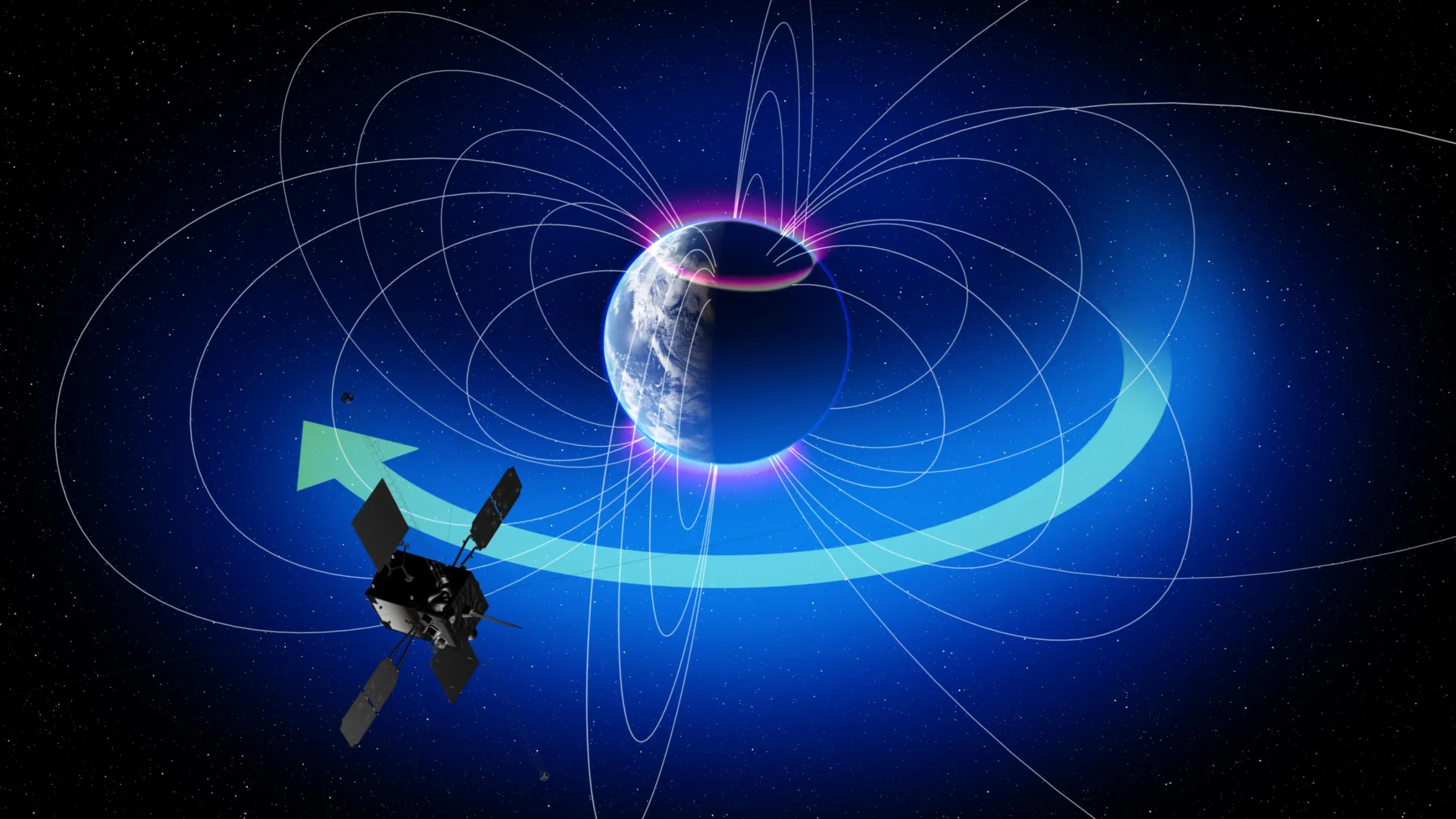
On May 10 and 11, 2024, a massive geomagnetic storm struck Earth's magnetosphere, reaching a SYM-H index minimum of minus-518 nanotesla. This represented the second-largest recorded disturbance since 1981. The storm began when a large sunspot released several powerful solar eruptions whose magnetized plasma clouds combined before colliding with Earth's magnetic field.
Japan's Arase satellite, launched in 2016 and operated by JAXA, captured unprecedented measurements of the ring current, the belt of energetic charged particles surrounding the planet. Arase passed through the ring current shortly after the storm began and again near its peak. The satellite's instruments measure both the mass and energy of individual ions, revealing the particle composition during this extreme event.
The discovery upended decades of assumptions. Scientists had expected the solar wind to supply most ring current ions during an intense geomagnetic storm with particularly dense solar material. Instead, approximately 85 percent of the ions came from Earth's own ionosphere, according to lead researcher Naritoshi Kitamura at Nagoya University's Institute for Space-Earth Environmental Research. The overwhelming contribution from atmospheric particles was "the first simultaneous observation of ring current ions and solar wind during a storm this large," Kitamura stated.
The heavier ions from Earth's atmosphere may have intensified the magnetic disturbance. Arase detected a 40 percent decrease in magnetic field intensity at roughly 16,000 kilometers above Earth, much closer than where similarly severe reductions had previously been documented. The satellite also detected a decline in energetic electrons normally circulating through this region.
Results published in Science Advances suggest that Earth's atmosphere plays a greater role in determining the severity of extreme geomagnetic storms than previously recognized. Current space weather forecasts rely heavily on solar wind conditions, but understanding how atmospheric ions escape into the magnetosphere could help make predictions more reliable. The findings support FACTORS, a proposed Japanese satellite mission designed to investigate how atmospheric particles enter space and influence powerful geomagnetic storms.