An international team led by Leiden University used LOFAR (LOw Frequency ARray) to produce the deepest image of low-frequency radio galaxies to date. The team observed ELAIS-N1, a region in the northern sky with minimal galactic dust, gas, and stars, making it ideal for deep multi-wavelength studies of the distant Universe.
The new image has twenty times the resolution of LOFAR's previous image of the region. It contains 63,000 radio sources, including quasars and star-forming galaxies, captured in an 8-billion-pixel image created from 200 hours of observation and 400 terabytes of data.
Processing such large datasets was previously impossible at this resolution. The Spider data-processing platform, developed by researchers from the Netherlands Institute for Radio Astronomy (ASTRON) and collaborators, reduced processing times by a factor of ten. "The entire dataset could be processed on Spider, the high-performance data processing platform hosted at SURF in the Netherlands, in just a few months," said Jurjen de Jong, postdoctoral researcher at Leiden Observatory and ASTRON who led the research.
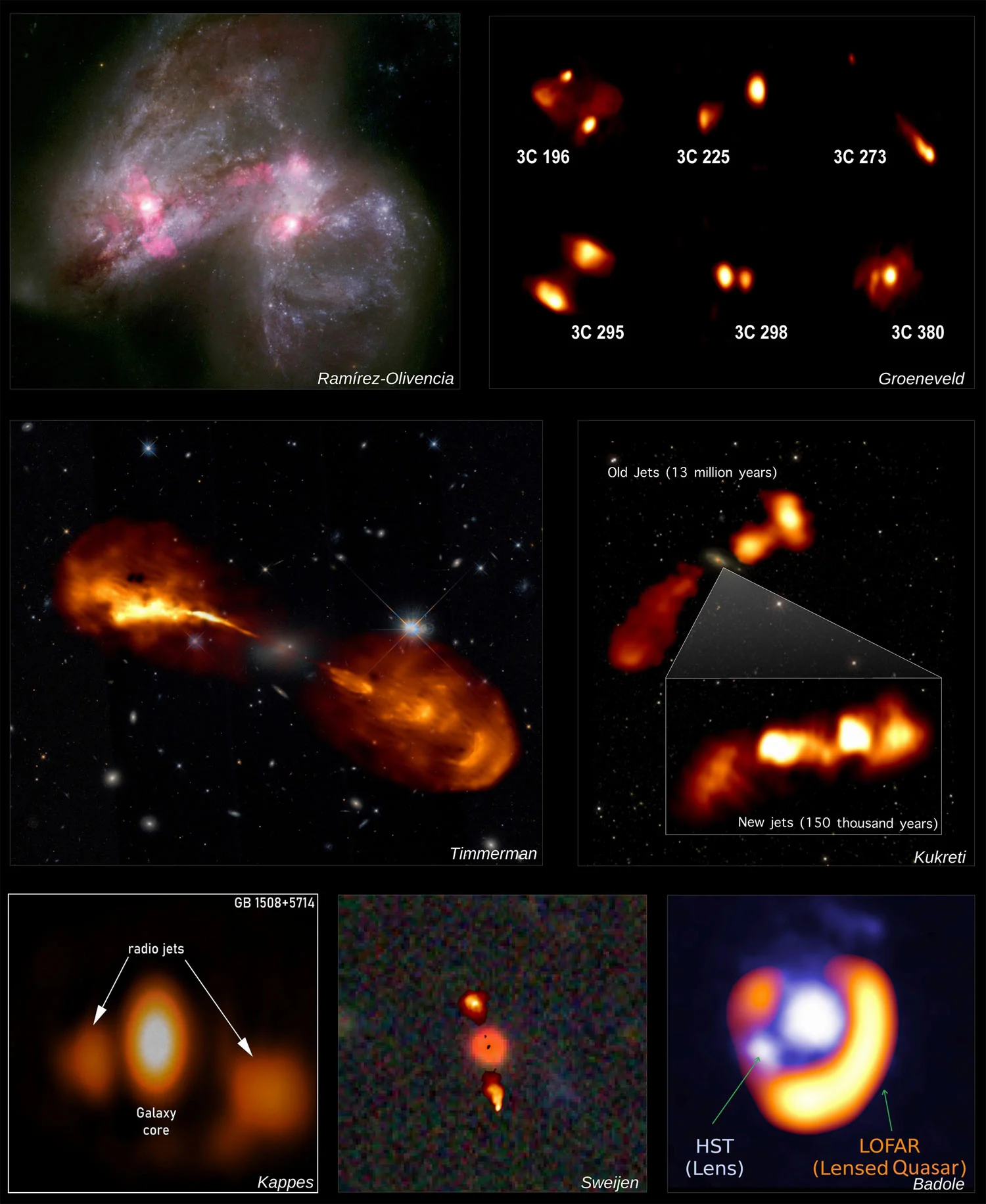
The high-resolution LOFAR data revealed filaments surrounding radio galaxies, especially near galaxy clusters. The image captures Active Galactic Nuclei (AGN), powered by supermassive black holes and their accretion disks, along with the relativistic jets of superheated gas and dust they produce. In previous lower-resolution surveys, these jets appeared as featureless blobs. LOFAR's detailed view allows scientists to trace individual jets and study how they interact with their environment over cosmic time.
The image also shows small, young star-forming galaxies. Radio observations penetrate gas and dust that obscure visible and infrared light, revealing star formation processes and how early Universe galaxies evolved into the older spiral and elliptical galaxies observed locally.
This work demonstrates the potential of LOFAR2.0, which ASTRON is developing with European partners. The upgrades will enable wider, higher-resolution images and keep LOFAR competitive with next-generation telescopes like the Square Kilometer Array (SKA).