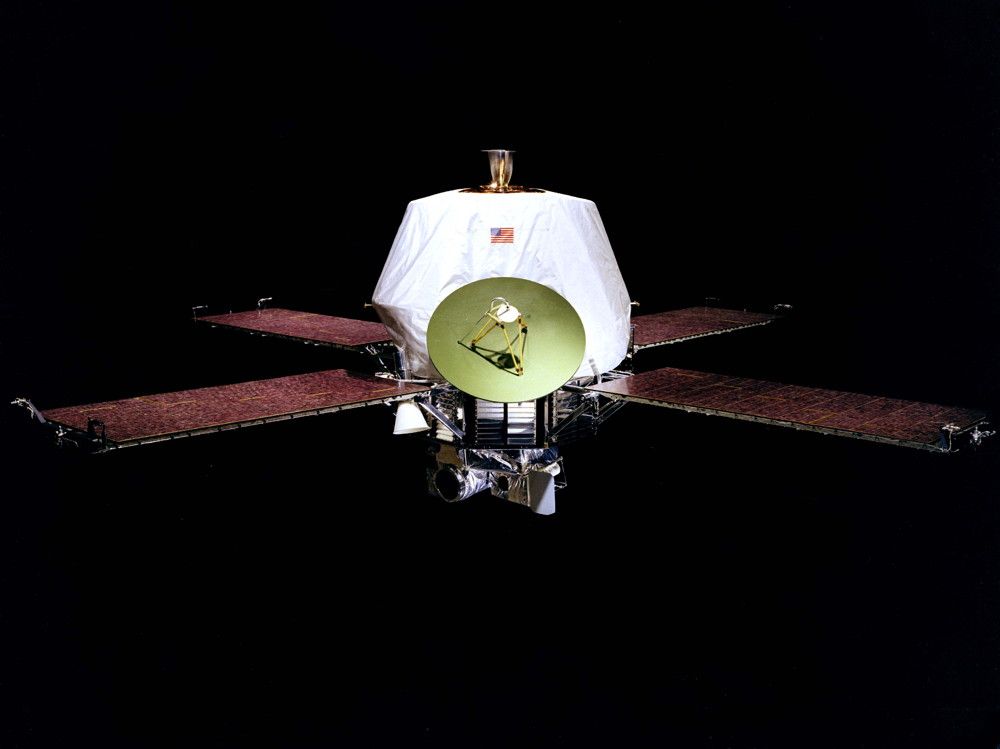
On Nov. 13, 1971, Mariner 9 became the first spacecraft to orbit Mars. The spacecraft arrived during a global dust storm, revealing towering structures that broke through the clouds. When the dust cleared, images showed these were the tops of giant volcanoes, including Olympus Mons, the tallest volcano in the solar system.
Mariner 9 also discovered Valles Marineris, an enormous canyon running 2,500 miles long and 120 miles wide across the Tharsis region. The canyon was named in honor of the spacecraft. Previous Mars flybys had shown only a cratered surface similar to the moon, but Mariner 9 transformed understanding of Mars into a geologically complex world.
The spacecraft carried four primary instruments: a camera system for imaging, an ultraviolet spectrometer, an infrared spectrometer, and an infrared radiometer. During its nearly one-year mission, Mariner 9 mapped 85 percent of Mars and discovered 20 giant volcanoes. The probe took 7,329 photos of the Martian surface, achieving a resolution between one-half and one mile per image. It also captured at least 80 photos of Mars's two small moons, Phobos and Deimos.
NASA shut down Mariner 9 in October 1972 after its supply of gaseous nitrogen for attitude control thrusters ran dry by February 1972. The spacecraft beat the Soviet Union's Mars 2 to orbit, though Mars 2 impacted the surface first after arriving with an 11-day head start.