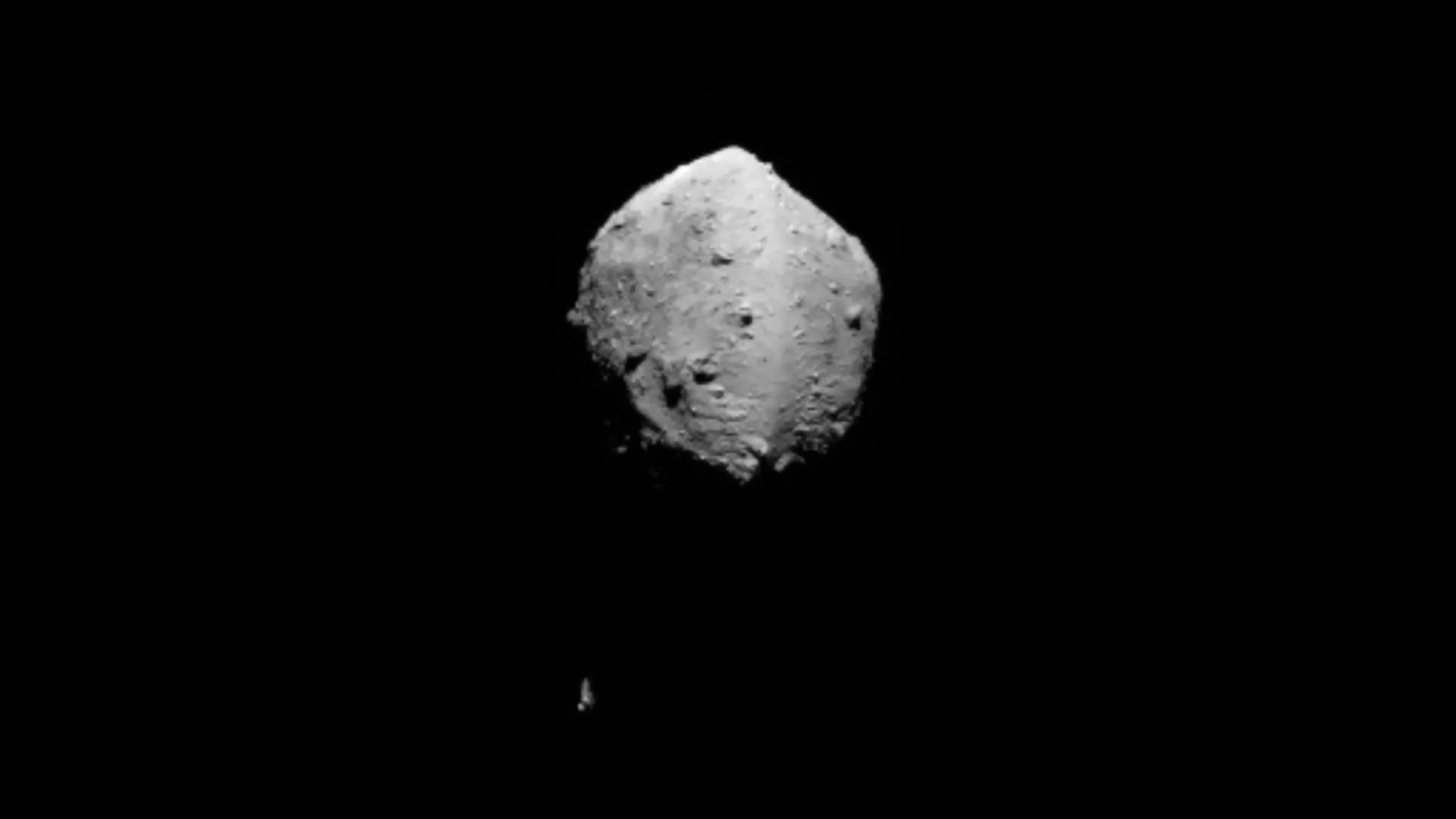
The European Space Agency's Hera spacecraft has captured its first close-up image of the Didymos asteroid system from a distance of 60 km, revealing a previously unseen side of the larger asteroid. The image was taken using Hera's monochromatic Asteroid Framing Camera.
On September 26, 2022, NASA's DART spacecraft deliberately crashed into Dimorphos, the smaller asteroid in the binary system measuring 151 m across. The larger Didymos has a diameter of 780 m. DART struck Dimorphos at approximately 6.1 km/s, reducing the smaller asteroid's orbital period around Didymos by about 33 minutes. This made Dimorphos the first object in the Solar System to have its orbit measurably altered by human activity.
The newly visible side of Didymos displays a central ridge along its equator, multiple boulders, craters, and patterns of grooves or ridges. Patrick Michel, Hera Principal Investigator and Director of Research at CNRS / Observatoire de la Côte d'Azur, said: "This is the other side of Didymos from the one that DART's camera showed us shortly before impact, so this feels like looking at a whole new world."
Scientists suspect that debris ejected from the DART impact may have traveled the roughly 1 km separating the two asteroids and reached Didymos. Michael Kueppers, Hera mission scientist, stated: "Since we expect a lot of impact-ejected material to have made it across the approximately 1 km of space from Dimorphos to Didymos, it may be that some of these characteristics originate from this transport of material, and we have exciting work ahead of us to sort it out."
Hera has traveled 196.8 million km from Earth over two years to reach the system. The spacecraft is now preparing detailed observations to understand the physical processes behind the orbit change. Detailed images of both asteroids are scheduled for November 25.