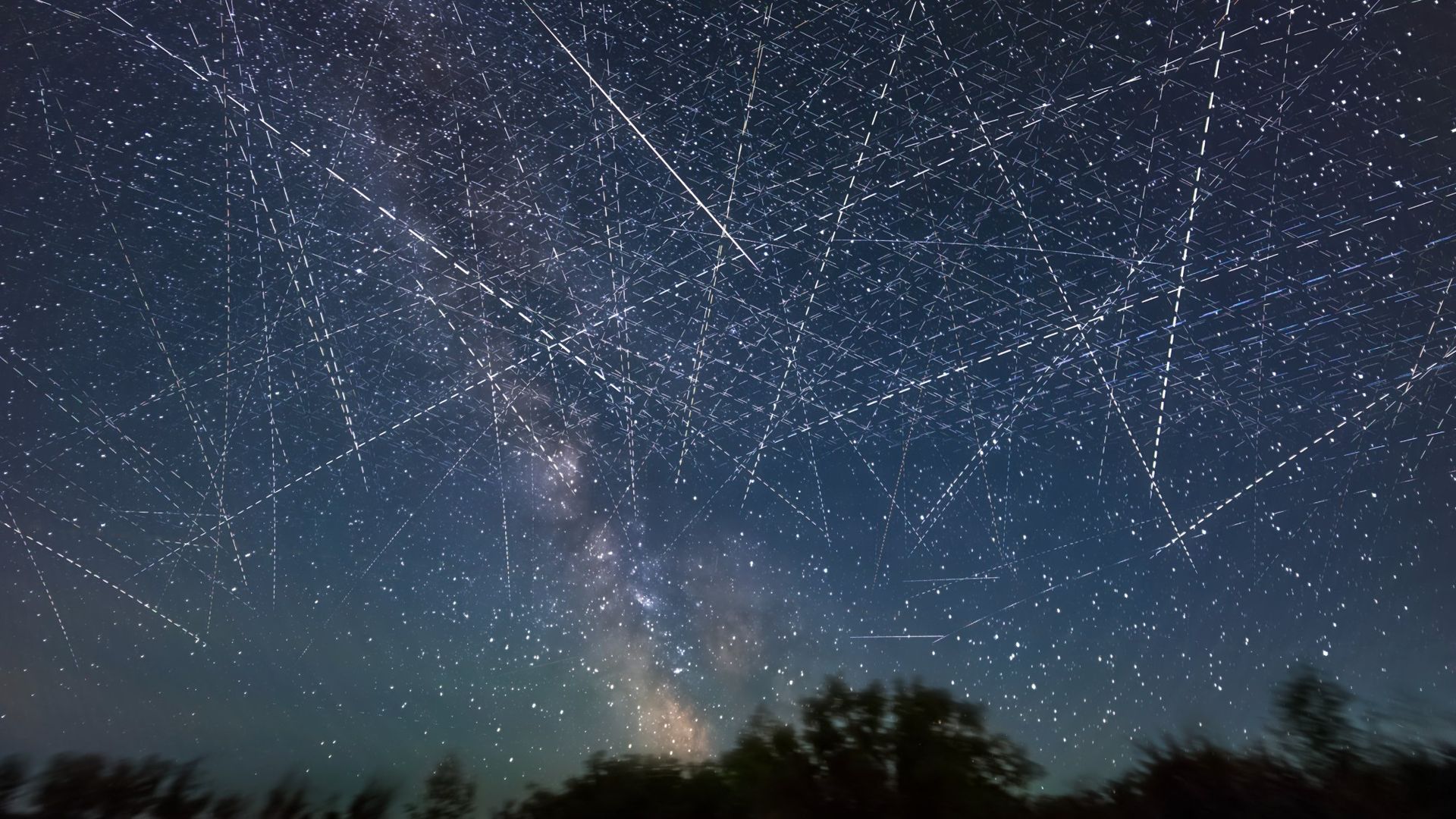
More than 700 satellites cross the sky over an average mid-latitude town at any moment during the night, according to an analysis of 15,833 active satellites in low Earth orbit below 1,200 miles altitude. Researchers from engineering firm Accu Components analyzed satellite trajectories using U.S. Space Force data from October 12 and 18, finding that above a typical U.K. town with an unobstructed horizon, 710 satellites occupy the sky at every instant after dark.
Not all those satellites are visible to the naked eye. Because satellites lack their own light, they must be illuminated by the sun while the ground has entered darkness. The analysis found that an average of 105 of the 710 satellites were bright enough to see, shining as bright as stars. The number of visible satellites shifts dramatically throughout the night. In the first hour after dusk, around 300 satellites catch sunlight above a typical U.K. town. By midnight, fewer than 20 remain visible. The count climbs back to around 300 before dawn.
For comparison, light-polluted cities like London or New York show as few as a few dozen visible stars at night. Suburban areas reveal a few hundred stars. Remote countryside or isolated mountains are required to see thousands of stars.
The orbital distribution of satellites affects visibility across latitudes. Most Starlink satellites orbit at around 53 degrees to the equator, clustering over mid-latitudes between 40 and 50 degrees north or south. Skies near the equator are quieter, with around 490 satellites visible at any moment.
Throughout a full night, an average U.K. town sees 12,891 different satellites passing overhead. The number of satellites in orbit has grown steeply over the past decade, particularly since SpaceX began launching its Starlink constellation. Satellite companies plan to launch hundreds of thousands, possibly millions of satellites in coming decades. Astronomers worry these satellites will impair ground-based telescopes by creating streaks in images and increasing sky brightness through reflected light, potentially degrading humanity's ability to study distant stars and galaxies.