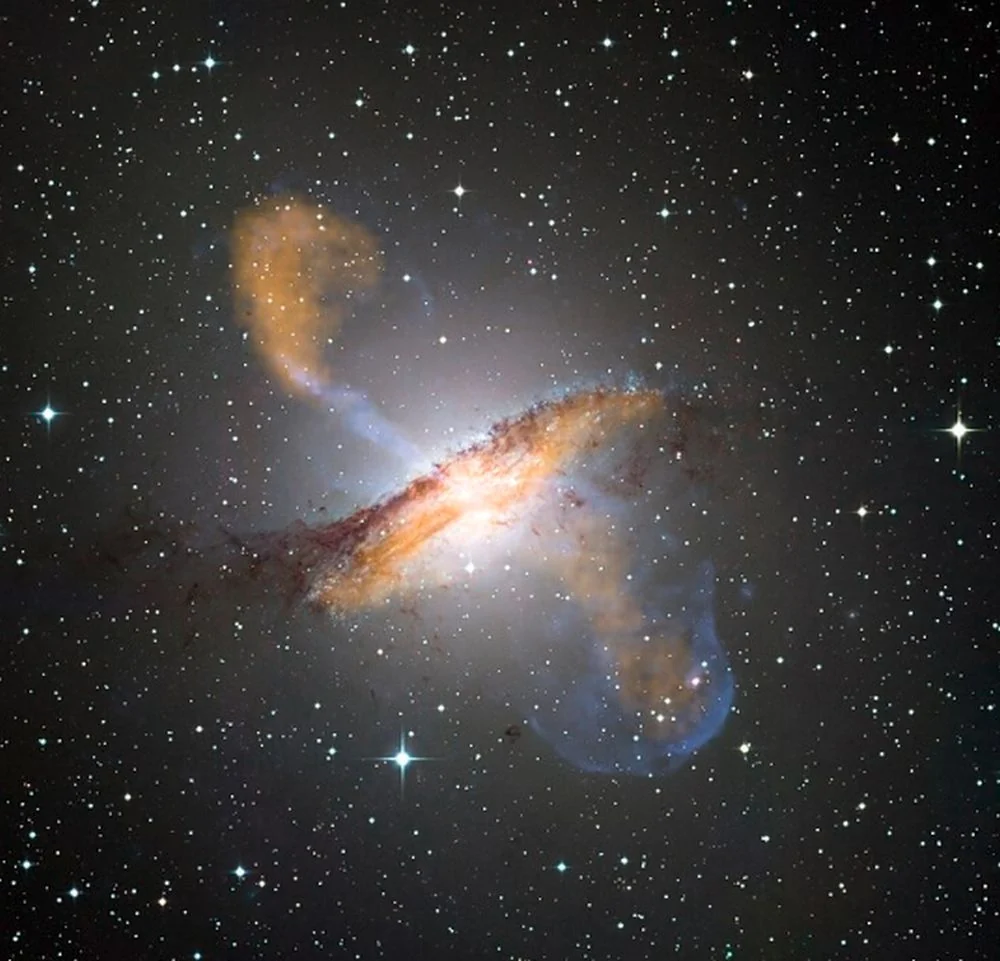
Supermassive black holes launch powerful jets of material at relativistic speeds, and new research explains why these jets appear brighter at their edges than at their centers, a phenomenon called limb brightening.
The jets originate from active galactic nuclei, where material spirals into an accretion disk around a supermassive black hole, heats up, and gets ejected by the black hole's rotational energy and magnetic fields. Researchers have observed this edge brightening in multiple galaxies, including Centaurus A, M 87, and 3C 84, using the Event Horizon Telescope and other high-resolution radio observations.
A new study published in Astronomy and Astrophysics, led by Felix Glaser of the University of Würzburg, used magnetohydrodynamic simulations to model the jets in Centaurus A. The simulation matched observations from the Event Horizon Telescope by including general relativistic effects and adjusting parameters like black hole mass and viewing angle.
The researchers found that the edge brightening results from an uneven distribution of electrons in the jets. The electrons emit synchrotron radiation as they follow magnetic field lines, and the brightness of this radiation depends on the pitch angle, the angle between the magnetic field and each electron's velocity. The viewing angle determines how bright the radiation appears.
"Our results demonstrate that the edge-brightening observed in Cen A can be naturally reproduced by an anisotropic particle distribution," the authors wrote. "The fact that our plasma-informed model reproduces the observed edge brightening suggests that we are capturing an important piece of the underlying physics."
The Square Kilometre Array, expected to come online in 2027, will enable even more detailed observations of relativistic jets across the universe.