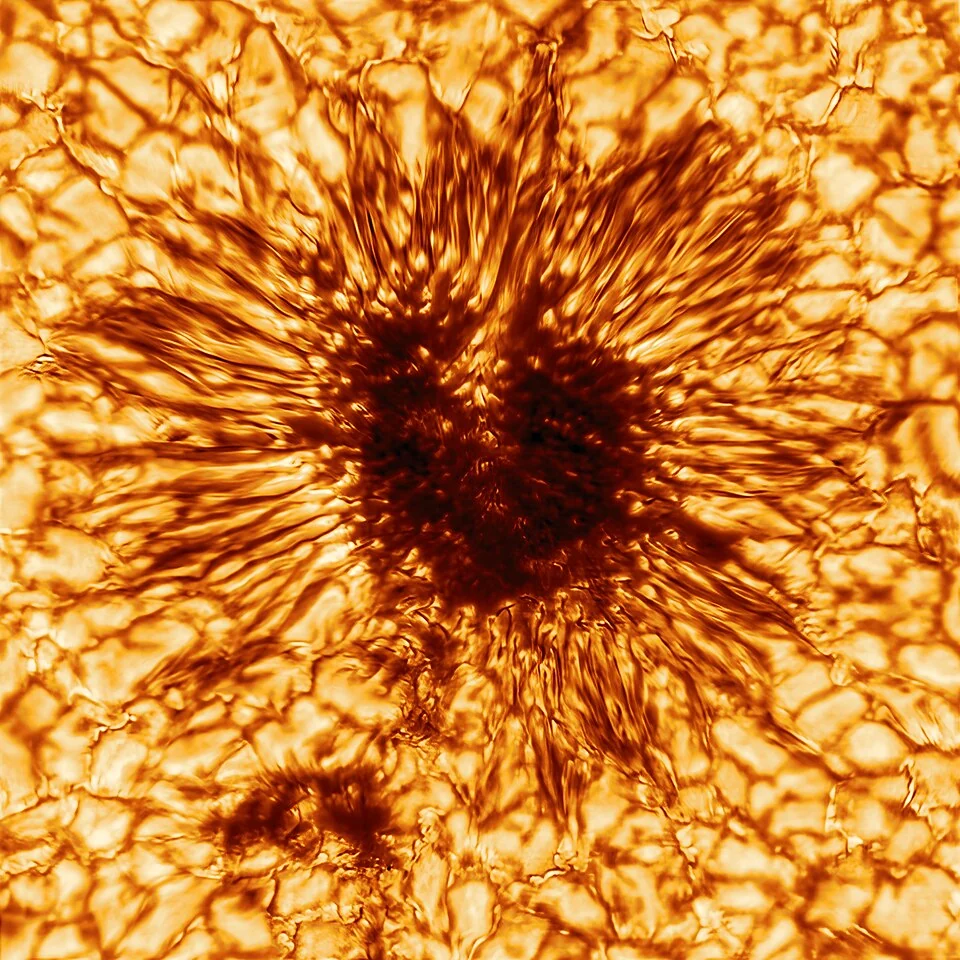
Researchers at China's Yunnan Observatories observed 176 dynamic fibrils, jets of plasma erupting from a sunspot, using the New Vacuum Solar Telescope on January 10, 2023. The fibrils launched at an average speed of 16 kilometers per second, faster than sound in the surrounding chromosphere, before slowing and falling back to the solar surface after about 4.5 minutes. Each fibril stretched roughly 1,130 kilometers on average.
The study, published in The Astrophysical Journal by Guotang Wu and Xiaoli Yan, combined observations from ground-based telescopes with data from China's CHASE satellite and NASA's Solar Dynamics Observatory. Researchers found that magnetoacoustic waves, generated by vibrating magnetic flux tubes beneath the Sun's surface, create sound waves that break in the chromosphere like waves on a beach. These breaking waves produce miniature sonic booms called magnetoacoustic shocks that push chromospheric plasma upward.
The orientation of magnetic field lines determines how the fibrils behave. When fields point straight up, plasma jets experience stronger deceleration and pulse at shorter intervals. When fields lean horizontally, fibrils decelerate more gently and pulse over longer periods. Data from the Solar Dynamics Observatory showed corresponding signatures of gas heated to hundreds of thousands or millions of degrees, indicating the shockwaves transfer energy directly into the solar corona. This addresses the long-standing puzzle of why the Sun's corona reaches temperatures hundreds of times hotter than its surface.