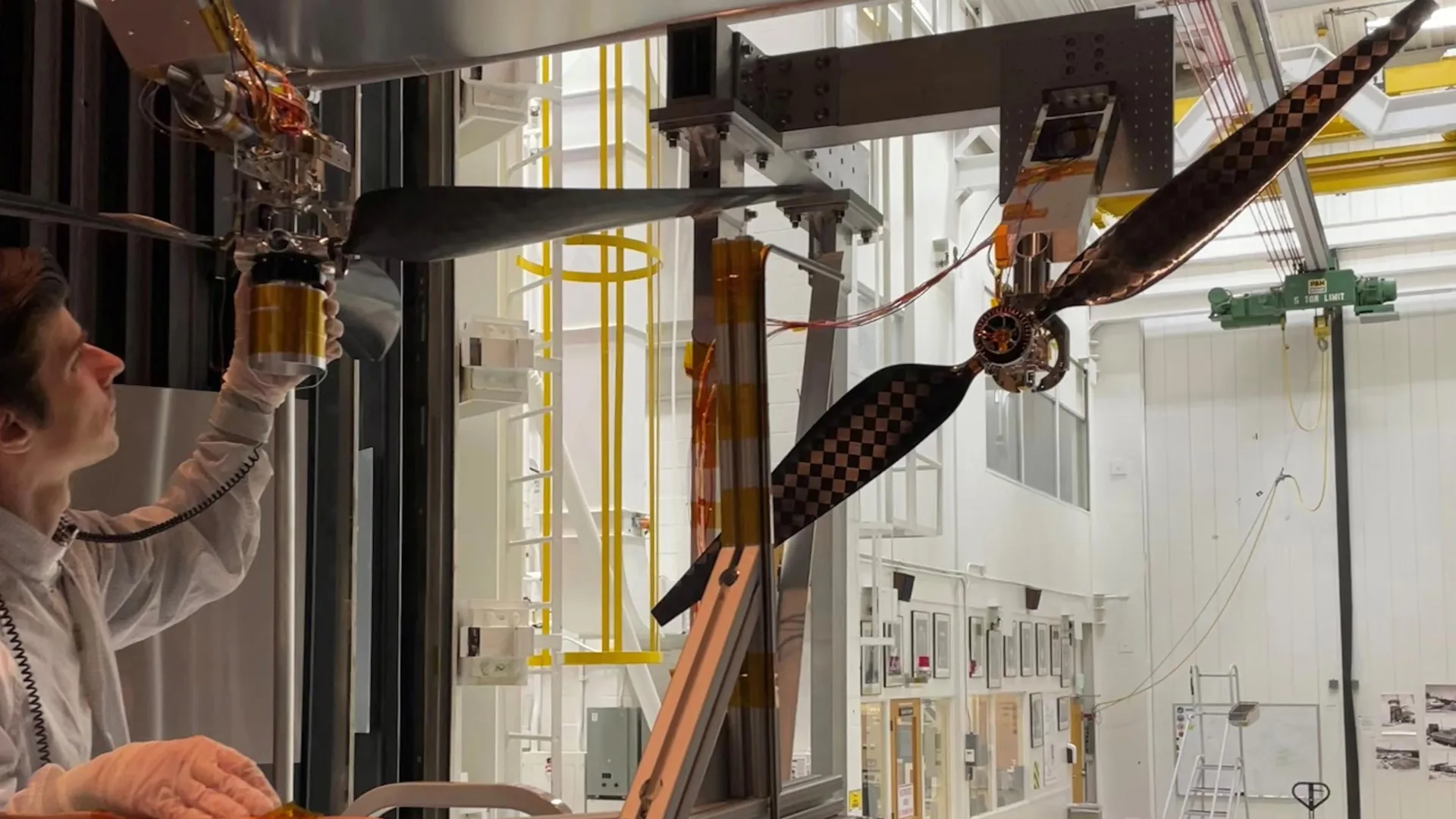
NASA engineers tested experimental Mars helicopter rotors at the Jet Propulsion Laboratory in March, spinning them beyond the speed of sound inside a chamber that reproduced Mars's thin atmosphere. The rotor tips reached Mach 1.08, exceeding the sound barrier and increasing lift capability by 30 percent. The blades survived the supersonic conditions without breaking.
The tests mark a step toward next-generation Mars aircraft. Ingenuity, which flew 72 times on Mars starting in April 2021, operated at 2,700 revolutions per minute, keeping rotor tips at Mach 0.7 to maintain a safety margin. Engineers limited those speeds because Mars's thin atmosphere, about 1 percent as dense as Earth's, requires rotors to spin much faster to generate lift. Sound travels at roughly 540 mph on Mars, compared to 760 mph at sea level on Earth.
The new rotors tested during 137 runs reached 3,750 revolutions per minute in one configuration and 3,570 revolutions per minute in a second design intended for NASA's SkyFall project. The additional lift capability could allow future helicopters to carry heavier scientific instruments and batteries, enabling longer flights and more ambitious investigations.
"The successful testing of these rotors was a major step toward proving the feasibility of flight in more demanding environments, which is key for next-gen vehicles," said Shannah Withrow-Maser, an aerodynamicist from NASA's Ames Research Center.
NASA plans to send three next-generation helicopters to Mars aboard SkyFall in December 2028. These aircraft would operate in locations difficult for rovers to reach and gather information from low altitudes.