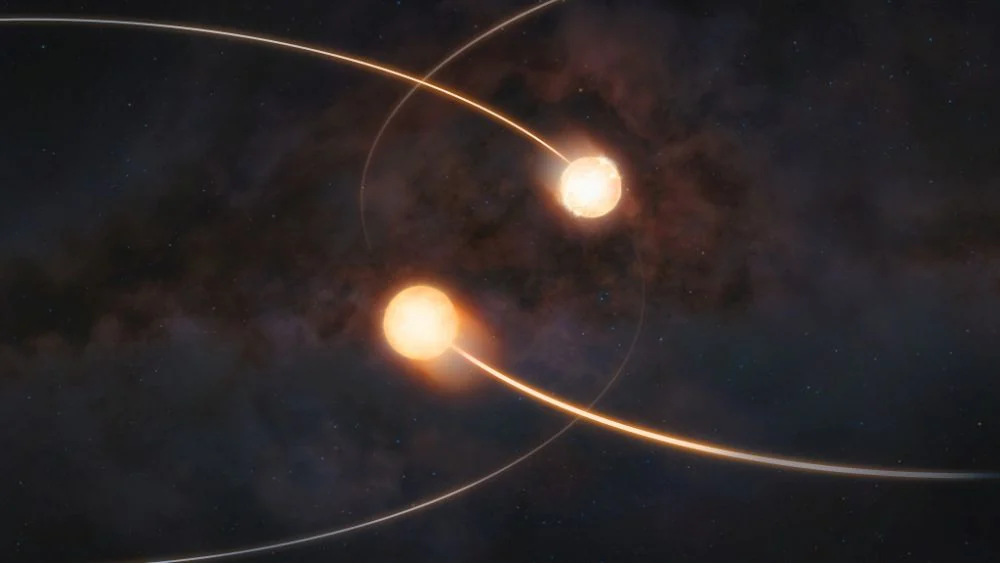
Astronomers used the Very Long Baseline Array to measure the orbits and masses of DG CVn, a binary pair of red dwarfs located about 59 light years away, with unprecedented precision. The measurements appear in a new paper in Astronomy and Astrophysics led by Paul Boven of the Joint Institute for Very Long Baseline Interferometry ERIC and Leiden Observatory.
One member of DG CVn is a Complex Periodic Variable star, or CPV star, a young M dwarf between 10 and 100 million years old that displays sharp dips in its optical light curve rather than the smooth dips typical of other stars. This marks the first dynamical mass measurement of a binary system containing a CPV star.
The VLBA, a network of 10 radio telescopes across the USA each measuring 25 meters, tracked the radio emissions from both stars over observations spanning 18 years, with especially precise data collected between 2023 and 2025. The array tracked the gravitational wobble each star induces in the other, allowing the researchers to determine their orbital and physical properties with exceptional accuracy.
The two stars orbit each other every 4.511 years on an elongated elliptical orbit. DG CVn A contains 0.39 solar masses and DG CVn B contains 0.36 solar masses. The researchers determined the orbital period to within 0.027 days and the distance to within 0.0033 parsecs, achieving a mass precision of 0.16 percent.
Because the two stars are so close together, their protoplanetary disks would have been limited in size, constraining any exoplanets to small sizes. The researchers estimate an exoplanet orbiting one star could only remain in a stable orbit if its period was less than approximately 23 days. A planet orbiting both stars would need an orbital period of at least about 36 years.
Jay Blanchard, an astronomer at the National Radio Astronomy Observatory and study co-author, noted that "by following these two stars over many years, we can see their orbital motion directly and use that motion to determine properties that would otherwise be extremely difficult to measure."