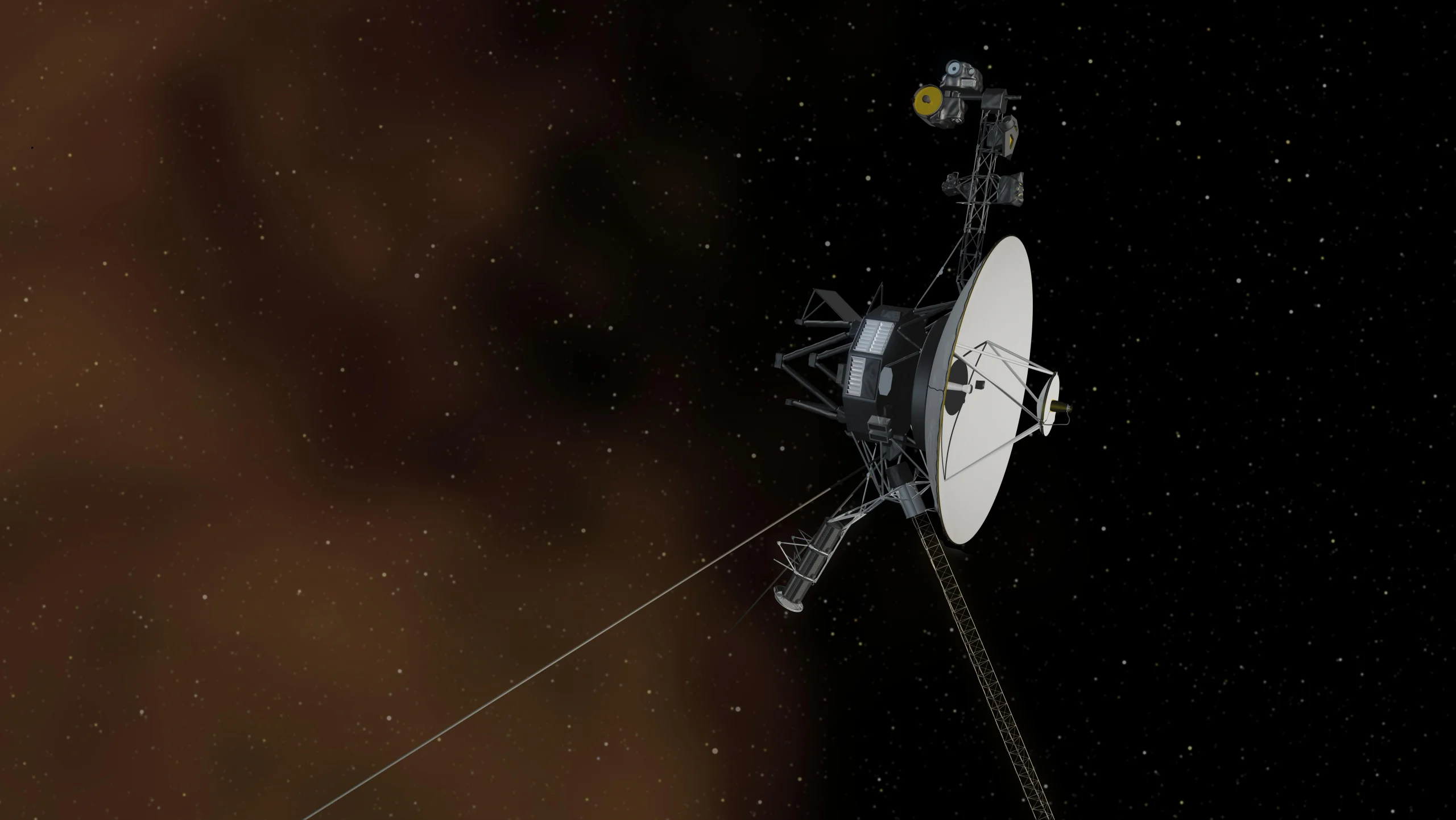
Voyager 1 reached a distance of one light-day from Earth on Nov. 18 at 5:16:07 AM EST, traveling 26 billion km from its home planet. Nearly 50 years after its launch in September 1977, the spacecraft achieved this milestone in its ongoing Voyager Interstellar Mission.
NASA conceived the Voyager probes in the late 1960s and early 1970s as part of the Planetary Grand Tour program. Scientist Gary Flandro discovered in 1964 that a planetary alignment occurring once every 175 years would allow spacecraft to visit the outer planets via gravitational assists. His calculations showed 1977 as the optimal launch window. Budget constraints shelved the full program in December 1971, but NASA scaled it down to build two probes using Mariner hardware. The program was renamed Voyager in March 1977.
Voyager 1 and Voyager 2 launched in September and August 1977 respectively. Each probe had a mass of 815 kg at launch and operates on a radioisotope thermoelectric generator powered by Plutonium-238 decay, producing 470 watts at launch. A single 3.7-meter radio antenna handles communications. Each spacecraft carries a Golden Record, a 30-centimeter copper phonograph record plated in gold, containing greetings in 55 languages, Earth sounds and music, images of Earth, and a pulsar map showing Earth's location relative to 14 neutron stars.
Voyager 1 launched aboard a Titan IIIE rocket from Cape Canaveral Air Force Station. Despite launching 16 days after Voyager 2, it passed its twin on Dec. 19, 1977, taking a shorter trajectory. The spacecraft approached Jupiter in January 1979 and came within 280,000 km at closest approach on March 5. During this flyby, Voyager 1 discovered two new moons, Metis and Thebe, and made observations of Jupiter's radiation belts and rings.
Voyager 1 began observing Saturn on Aug. 22, 1980, achieving closest approach on Nov. 12 at 170,000 km from the cloud tops. It discovered five new moons, revealed Saturn's G-ring, identified shepherd moons that shape the rings, and observed auroral activity in the polar regions. Observations of Titan revealed a thick nitrogen atmosphere and the presence of methane and other hydrocarbons, suggesting potential for prebiotic reactions.
The spacecraft's Saturn flyby trajectory flung it out of the ecliptic plane toward interstellar space. On Jan. 1, 1990, Voyager 1 began the Voyager Interstellar Mission, measuring magnetic fields, particles, and plasma waves as it traversed the termination shock, heliosheath, and interstellar space.