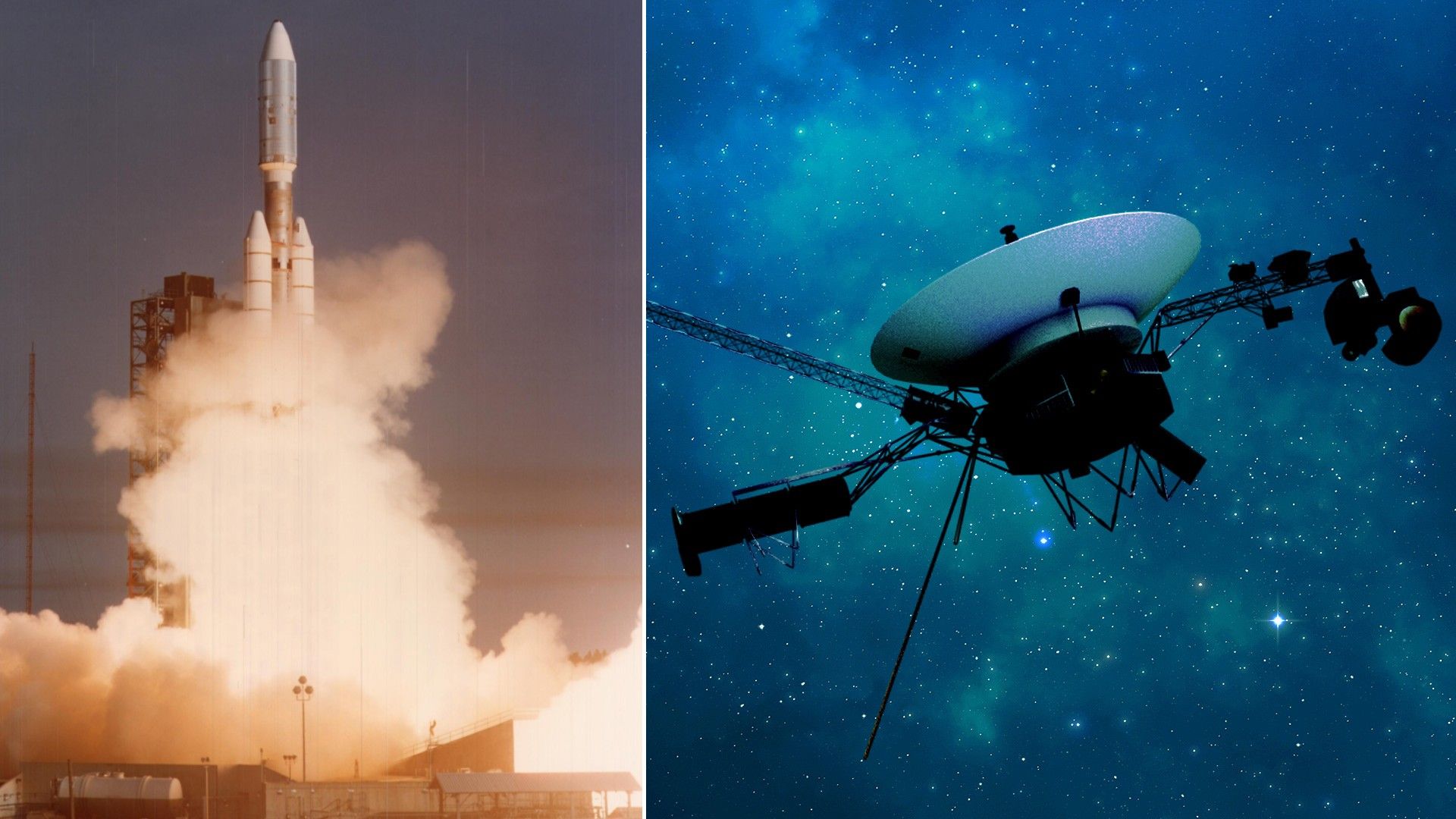
Voyager 1 reaches a light-day distance from Earth on November 18, when signals will take 24 hours to arrive at the spacecraft. That distance equals 16,094,799,096 miles (25,902,068,356 kilometers).
Voyager 2 will not reach this milestone until around 2035. The gap stems from trajectory choices made during the twin missions' planetary flybys beginning in 1977.
Both spacecraft launched about two weeks apart, with Voyager 2 first. NASA selected a faster trajectory for Voyager 1. Voyager 1 arrived at Jupiter on March 5, 1979. Voyager 2 reached Jupiter four months later on July 9.
Each spacecraft performed gravity assists at Jupiter and Saturn, gaining speed from the planets' gravitational pull. During the Jupiter encounter, each Voyager gained about 10 kilometers per second. The Planetary Society noted that Jupiter slowed down by roughly 10 to the negative 24th power kilometers per second, a change too small to measure.
Voyager 1 made a turn at Saturn to study the planet's rings and Titan before flying outside the solar system's plane. Voyager 2 continued to Uranus and Neptune, taking advantage of a rare planetary alignment. At Neptune, Voyager 2 performed a maneuver to fly by Triton that caused it to lose about 2 kilometers per second.
Voyager 1 now travels at 3.5 astronomical units per year. Voyager 2 moves at 3.1 astronomical units per year. Both reached interstellar space, Voyager 1 in 2012 and Voyager 2 in 2018.
NASA's Jet Propulsion Laboratory manages both missions and has been turning off instruments to redistribute power. The spacecraft could operate into the 2030s if their nuclear power sources last.